Crime-as-a-Service (CaaS) Matures: How Anyone Can Launch a Sophisticated Attack in 2026
Crime-as-a-Service has evolved from underground forums trading scripts into a mature ecosystem that mirrors legitimate SaaS and gig platforms. In 2026 attackers do not need deep technical skills to execute complex campaigns. They can rent initial access, subscribe to ransomware toolkits, outsource phishing operations, buy infostealer logs, and spin up botnets on demand. Packages come with dashboards, SLAs, technical support, onboarding guides, and even affiliate revenue splits. The barrier to entry has collapsed. The speed to impact has accelerated. And with AI woven into every layer of this economy, the distinction between an amateur and a seasoned operator is shrinking fast.
What CaaS looks like now
Modern CaaS is a supply chain with specialized roles that plug together like microservices. Rather than a single monolithic group doing everything, an attacker assembles a campaign from modular offerings.
Key suppliers in the CaaS stack
- Initial Access Brokers who sell footholds into corporate networks, cloud tenants, VPNs, and SaaS identities.
- Phishing-as-a-Service platforms that generate landing pages, infrastructure, and continuous lure variations.
- Malware and Exploit Developers offering loaders, crypters, and subscription updates with detection evasion.
- Ransomware and Extortion Operators that provide encryption kits, negotiation playbooks, and leak site hosting.
- Data Monetization Services that buy or broker stolen data, including payment card details and corporate IP.
- Money Laundering and Cash-out Networks that convert proceeds through crypto mixers, prepaid instruments, and mule herds.
Each role competes on features, automation, and customer service. Newcomers sign up, select a bundle, pay a fee, follow a playbook, and launch. This marketplace dynamic explains why lower skill actors can replicate high-skill outcomes.
How AI makes CaaS easier, faster, and more dangerous
Artificial intelligence now underpins every profitable stage of the CaaS lifecycle. It is not a futuristic add-on or a marketing buzzword. It is the engine of scale and personalization.
AI as the lead generator for attackers
Models ingest breach data, public profiles, vendor relationships, and technology fingerprints to prioritize targets with the highest likelihood of payout. An operator can upload a company list and receive ranked attack plans with suggested lures, potential identity weak points, and recommended third party pivots.
AI in content generation and social engineering
Phishing platforms use AI to create lures that mimic tone, timing, and brand voice. Voice cloning enables real-time vishing against helpdesks and finance teams. Deepfake snippets reinforce spoofed executive requests. AI continually A/B tests subject lines and call-to-action phrasing to boost success. The result is industrial scale personalization without human copywriters.
AI in exploitation and lateral movement
Agent-like tools enumerate environments, map privileges, and select tactics that will likely evade detection based on telemetry fingerprints. If a payload is blocked, the agent modifies the sequence and tries another path. Decision loops are measured in seconds. Playbooks are adapted mid-attack. This collapses defender dwell time and overwhelms manual triage.
AI in exfiltration and extortion
Once in, AI crawls file repositories, mailboxes, and chat histories to identify the most sensitive data and the individuals who care most about it. It drafts extortion notes tuned to industry language and regulatory exposure, calculates potential fines or outages, and recommends pressure tactics that are likely to move a victim to payment quickly.
What this means for security leaders
CaaS resets the economics of cyber risk. It increases attack volume, compresses timelines, and standardizes quality. Three implications stand out.
Volume defeats manual processes
Even the best analysts cannot triage thousands of micro alerts when the real signal is a sequence that looks legitimate in isolation. Teams need correlation that assembles narratives across identity, endpoint, cloud, and SaaS, and they need it in near real time.
Prevention can be bypassed but speed still matters
Perfect prevention is unrealistic when attackers purchase valid access and work within allowed tools. The goal becomes decision advantage. Detect early, decide quickly, and contain precisely. Mean time to understand must fall alongside mean time to respond.
Identity becomes the control plane
CaaS actors love legitimate credentials because they reduce noise. Programs that treat identity as a first class signal will outperform those that still anchor on perimeter and signatures. Protect identities, monitor their behavior, and respond at the session and token level.
The CaaS attack lifecycle in 2026
Breaking the campaign into stages helps you place controls where they have the biggest impact.
Stage 1: Target profiling and access purchase
An operator picks a sector, uploads a prospect list, and buys either ready-made logins or a phishing bundle. AI ranks the list by perceived value and exposure. If a company uses a vulnerable edge device or has inconsistent MFA, it moves to the top.
Defender focus:
- Attack surface reduction on external services and identity providers.
- Continuous control validation for MFA coverage, conditional access, and passwordless posture.
- Threat intel integration that flags your org appearing in access broker listings.
Stage 2: Initial intrusion and session establishment
The operator launches a phishing kit that auto-generates site clones and domains, or uses purchased credentials to authenticate. If challenged by MFA, they run fatigue attacks, SIM swap social engineering, or abuse OAuth consent flows. Once authenticated they register a malicious app or create persistence via tokens.
Defender focus:
- Monitor authenticator lifecycle events, OAuth grants, and token issuance.
- Enforce admin consent for high-risk scopes and restrict user consent to allowlisted apps.
- Alert on suspicious session creation tied to new device fingerprints or unmanaged hosts.
Stage 3: Privilege escalation and lateral movement
Using agent-like tooling, the attacker enumerates permissions, shared resources, and cross-tenant links. They escalate through misconfigurations, weak role boundaries, or forgotten service accounts. Movement often occurs within SaaS and cloud control planes, not just across endpoints.
Defender focus:
- Identity-first analytics that spot unusual role assignments, policy edits, and first-time access to privileged consoles.
- Least privilege by default, just-in-time admin elevation, and removal of standing access.
- Correlation of identity events with endpoint and cloud actions to build a storyline, not a list.
Stage 4: Data discovery, collection, and exfiltration
CaaS playbooks prioritize high-leverage data. AI labels content by sensitivity and business impact. Exfiltration avoids spikes by trickling through sanctioned channels, cross-tenant shares, or app-to-app syncs. Meanwhile backups and snapshots may be sabotaged to raise leverage.
Defender focus:
- Content-aware monitoring for sensitive repositories with behavior baselines per user and team.
- Detection of quiet exfiltration patterns and unusual destinations, including unfamiliar tenants and webhooks.
- Backup integrity controls, immutable storage, and alerts on deletion or retention changes.
Stage 5: Monetization through extortion and disruption
With data staged, the operator deploys encryption selectively or not at all. They push extortion messages tailored to the victim’s regulatory and reputational risk. Some crews pair threats with harassment, public leaks, or automated outreach to customers to maximize pressure.
Defender focus:
- Prebuilt communication playbooks and legal coordination for extortion events.
- Rapid containment that cuts off attacker sessions, revokes grants, and isolates affected assets.
- Crisis exercises that include decision frameworks for disclosure, law enforcement engagement, and business continuity.
Why smaller actors can now run big-league campaigns
Mature CaaS means that sophistication is rentable. Three features of the market enable this.
Feature 1: Productization and support
Turnkey portals guide operators from target selection to payout. Support channels fix broken payloads and recommend evasion tweaks. Documentation shortens the learning curve. This professionalization multiplies attacker productivity.
Feature 2: Specialization and competition
Each supplier competes on speed, stealth, and conversion rate. Competition drives innovation and lowers cost. Operators swap vendors with minimal friction when a tool is burned. The market rewards the path of least resistance.
Feature 3: AI accelerators across the stack
From target ranking to exploit suggestions to automated negotiation messages, AI becomes an equalizer. Less-skilled operators can deploy campaigns that previously required a small team of experts.
Defense principles that work against CaaS
You cannot control attacker economics but you can make your environment expensive to attack and easy to defend. Anchor your strategy to five principles.
Principle 1: Identity-centric detection and response
Treat identity signals as critical infrastructure. Watch for suspicious authenticator changes, new OAuth grants with sensitive scopes, token anomalies, and role or policy drift. Map identity events to endpoint and cloud actions so you catch the narrative, not just the noise.
Principle 2: Reduce the space for experimentation
CaaS thrives on rapid iteration. Remove standing admin permissions and enforce least privilege with just-in-time elevation. Close self-service consent and enforce app allowlists. Shorten token lifetimes for high-risk apps and require step-up verification for sensitive actions.
Principle 3: Build narrative correlation, not alert piles
Shift from isolated alerts to attack stories that explain who did what, with which identity, against which data, and why it matters. Equip analysts with investigation surfaces that stitch identity, SaaS, endpoint, and network into a single timeline.
Principle 4: Automate safe containment
Pre-approve actions that disable malicious grants, revoke sessions, isolate affected devices, roll back privilege changes, and block suspicious destinations. Automate where confidence is high and build guardrails and rollbacks to preserve business continuity.
Principle 5: Test like an operator
Run exercises that mimic CaaS. Buy a benign app from a marketplace and test consent boundaries. Simulate OAuth persistence, quiet exfiltration via collaboration tools, and helpdesk social engineering for authenticator recovery. Measure how quickly your team detects and contains each stage.
A 90-day execution plan to harden against CaaS
You do not need a multiyear overhaul to start closing gaps. Use the first quarter to create momentum.
Days 1 to 30: Visibility and hygiene
- Inventory OAuth grants, service principals, and authenticator changes across key SaaS platforms.
- Disable open user consent for high-risk scopes and enforce admin approval with business justification.
- Shorten token lifetimes for sensitive applications and require step-up verification for destructive changes.
- Identify and remove standing privileged accounts. Establish just-in-time elevation for at least one high-value admin group.
Days 31 to 60: Detection and correlation
- Onboard identity, SaaS, endpoint, and network logs into a unified investigation surface.
- Deploy detections for grant creation followed by unusual API reads, first-time access to privileged consoles, and off-hours bulk access.
- Baseline behavior for key teams and sensitive repositories.
- Build initial playbooks for grant revocation, token invalidation, and share quarantine.
Days 61 to 90: Response and resilience
- Run a tabletop simulating a CaaS-style intrusion that uses OAuth persistence and quiet exfiltration.
- Automate containment actions for high-confidence patterns with approvals and audit trails.
- Validate backup immutability and alerts on retention changes.
- Establish quarterly reviews for third party apps, grants, and privileged roles.
Metrics CISOs should track in a CaaS world
- Time to detect suspicious identity activity after successful authentication.
- Time to revoke malicious app grants or tokens once detected.
- Percentage of sensitive apps behind step-up verification and reduced token lifetimes.
- Reduction in standing privileges and increase in just-in-time usage.
- Coverage of SaaS grant inventory under admin control and allowlists.
- Mean time to build an end-to-end incident narrative across identity, SaaS, endpoint, and network.
How ThreatResponder helps shrink CaaS advantage
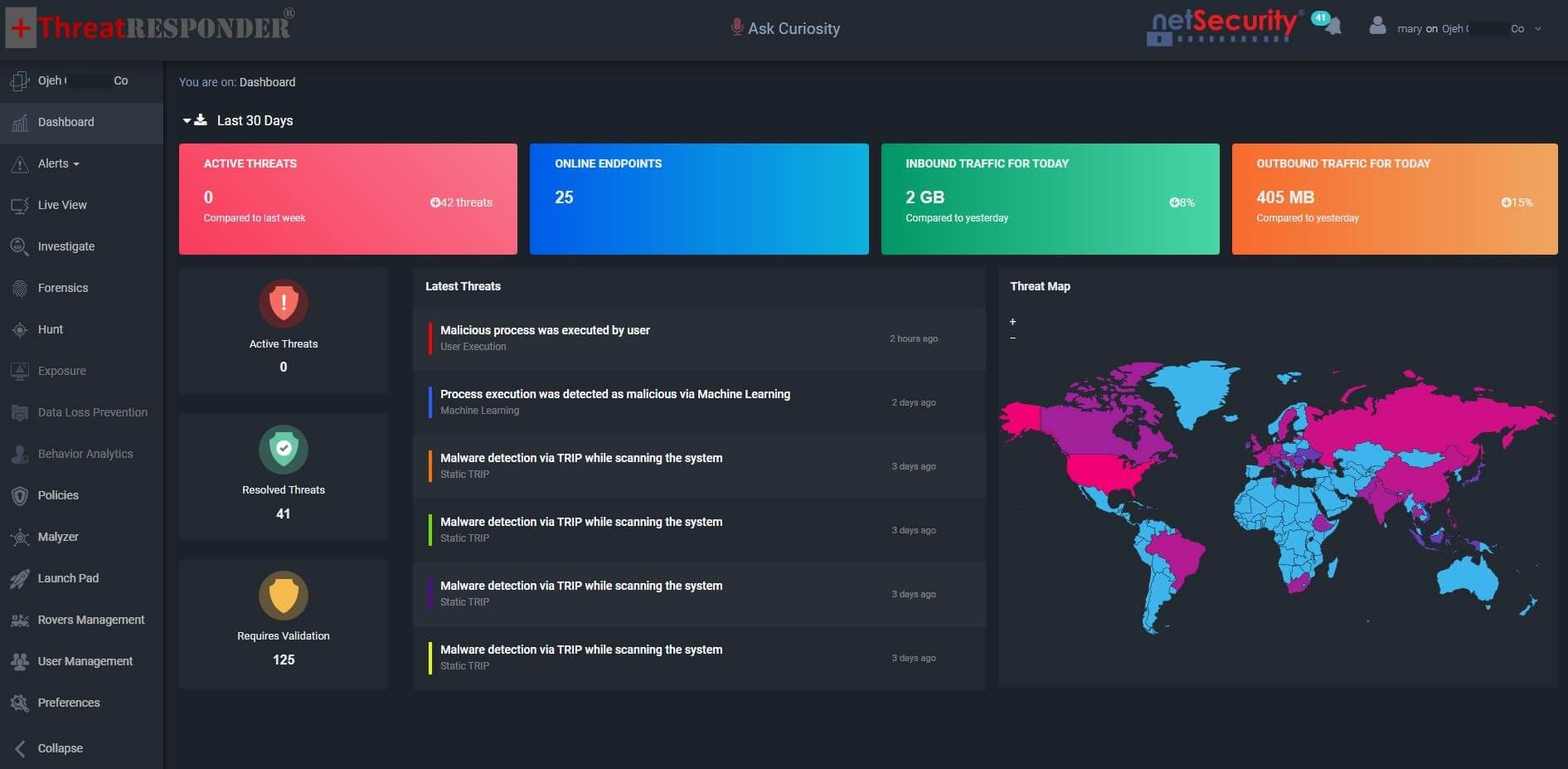
CaaS wins by exploiting fragmentation. ThreatResponder helps your team take back the initiative by unifying context and accelerating precise action.
Unifying identity, SaaS, endpoint, and network into one narrative
ThreatResponder correlates authenticator events, OAuth grants, token usage, role changes, API activity, process executions, and egress destinations into a single timeline so analysts can see the full campaign, not scattered clues.
Detecting the sequences that matter
Instead of flagging every anomaly, ThreatResponder highlights suspicious chains like grant creation followed by first-time access to a sensitive repository and then data movement to an unfamiliar tenant. This narrative focus cuts through noise and surfaces real intrusions earlier.
Responding at machine speed with guardrails
ThreatResponder enables rapid, controlled actions such as revoking grants and tokens, isolating devices, rolling back privilege changes, and enforcing step-up verification for affected identities. Playbooks are auditable and reversible to minimize business disruption.
Reducing analyst fatigue while improving outcomes
By converting raw telemetry into prioritized, context-rich incidents, ThreatResponder shortens investigation time and helps teams make better decisions under pressure. That is how you counter an ecosystem built to move faster than human response.
Stay Protected with ThreatResponder
Crime-as-a-Service is accelerating, and attackers now operate with automation, AI assistance, and off‑the‑shelf sophistication. Defenders need unified visibility, fast correlation, and precise response. ThreatResponder gives security teams the advantage with identity‑centric detection, narrative‑driven investigations, and rapid, controlled containment to stop CaaS‑powered attacks before they cause impact.
Disclaimer
The page’s content shall be deemed proprietary and privileged information of NETSECURITY CORPORATION. It shall be noted that NETSECURITY CORPORATION copyrights the contents of this page. Any violation/misuse/unauthorized use of this content “as is” or “modified” shall be considered illegal and subjected to articles and provisions that have been stipulated in the General Data Protection Regulation (GDPR) and Personal Data Protection Law (PDPL).