Why Mythos matters right now
For decades, vulnerability discovery relied on the labor of expert researchers, targeted fuzzing, and time consuming manual reasoning. Mythos compresses that cycle into hours or minutes by combining advanced coding ability, reasoning, and autonomous task execution. This shift fundamentally changes the risk landscape for enterprises and for critical infrastructure operators who depend on complex, legacy heavy software stacks.
What Anthropic Mythos is?
Mythos is a frontier artificial intelligence model developed by Anthropic and released under highly restricted conditions. It is not a consumer AI assistant and not a general public product. Mythos was identified internally as possessing emergent cybersecurity capabilities powerful enough to warrant controlled access. Anthropic determined that unrestricted release would pose unacceptable systemic risk due to Mythos’s ability to autonomously discover and reason about software flaws at a level comparable to elite human researchers.
At its core, Mythos is a general purpose model optimized for code comprehension, vulnerability reasoning, and multi step problem solving. What distinguishes it is not a single exploit technique but the ability to chain analysis, hypothesis testing, and validation without continuous human guidance.
Who built Mythos and why it was restricted
Anthropic was founded by researchers with a strong emphasis on AI safety and alignment. Mythos emerged during internal evaluations of next generation coding capabilities rather than as a dedicated hacking tool. During testing, researchers observed that the model could identify previously unknown vulnerabilities across widely used operating systems, browsers, and core infrastructure software.
Recognizing that the same capabilities that benefit defenders could rapidly empower attackers, Anthropic chose to restrict access and created a limited deployment framework known as Project Glasswing. Through this framework, select organizations with responsibility for critical software and infrastructure were given access for defensive purposes while broader governance questions are addressed.
Core capabilities of Mythos
Mythos introduces several capabilities that together redefine vulnerability discovery.
Autonomous reasoning over large codebases
Unlike traditional scanning tools that rely on signatures or random input generation, Mythos reasons about software logic. It reads source code, infers developer intent, identifies unsafe assumptions, and tests those assumptions systematically. This allows it to uncover flaws that have survived decades of scrutiny.
Exploit chain construction
Mythos does not stop at identifying isolated bugs. It can reason about how multiple weaknesses interact and build exploit chains that lead from minor memory corruption or logic errors to full system compromise. This capability is particularly impactful because exploit chains are often the hardest part of advanced attacks.
End to end task execution
Given a high level objective, Mythos can plan and execute the steps required to achieve it. This includes writing code, validating behavior in test environments, adjusting hypotheses, and refining results. The effect is a drastic reduction in the time between discovery and weaponization.
Adaptability across environments
Mythos demonstrates effectiveness across diverse environments including operating systems, browsers, virtualization platforms, and cloud services. This breadth matters because modern enterprises rely on interconnected components rather than isolated systems.
Why this changes the economics of vulnerability discovery
Before Mythos, vulnerability research was constrained by human attention and skill availability. Even highly automated fuzzing required expert tuning and interpretation. Mythos removes many of these bottlenecks.
For defenders, this means the number of discovered vulnerabilities will increase dramatically. For attackers, it means the barrier to finding exploitable flaws will fall rapidly once similar capabilities proliferate beyond controlled programs. The result is a widening gap between vulnerability discovery speed and patch deployment speed.
The impact on critical infrastructure
Critical infrastructure environments face disproportionate risk from AI accelerated vulnerability discovery due to several structural factors.
Legacy software and hardware
Many operational technology and industrial control systems rely on software components that were not designed with modern threat models in mind. Some have remained unchanged for decades. Mythos excels at finding exactly these long lived flaws that traditional tools miss.
Patch latency
In IT environments, patches can often be deployed quickly. In OT and critical infrastructure, patching may require downtime, safety reviews, or physical access. As the discovery rate accelerates, unpatched windows grow more dangerous.
Converged IT and OT networks
Digital transformation has increased connectivity between enterprise IT systems and operational environments. Vulnerabilities discovered in shared components such as web interfaces, management software, or identity services can create paths into physical operations.
Exploit chain amplification
An exploit chain that begins in an enterprise management interface may lead into OT systems through trust relationships and shared credentials. Mythos’s ability to reason about these chains raises the likelihood of cross domain compromise.
How Mythos alters attacker and defender behavior
The existence of Mythos does not automatically mean attackers immediately gain access to similar power. However, it establishes a new baseline.
For attackers
Attackers will increasingly expect faster discovery cycles and may hold back exploits until high value windows emerge. Smaller groups may gain access to sophisticated techniques previously limited to nation state teams.
For defenders
Defenders must assume that unknown vulnerabilities exist at any given time and that discovery timelines are compressing. Static defense models that rely solely on patching known issues will be insufficient.
The current status of the Mythos program
As of now, Mythos remains restricted to a small set of organizations participating in Project Glasswing. These participants include technology providers, software maintainers, and institutions with responsibility for foundational digital infrastructure. The intent is to use Mythos defensively to identify and remediate vulnerabilities before equivalent capabilities become widely accessible.
Anthropic has been explicit that Mythos is an early example of a class of systems likely to emerge elsewhere. The timeline for broader availability of similar models is uncertain but expected to be measured in months to years rather than decades.
Governance and risk considerations
Mythos raises immediate questions around governance that CISOs cannot ignore.
Disclosure timelines
When vulnerabilities are discovered at scale, coordinated disclosure processes strain. Fixes may become public before advisories, creating exploit windows that attackers can exploit.
Supply chain exposure
Open source libraries and shared components become critical choke points. Vulnerabilities in widely used packages can cascade across industries faster than organizations can react.
Regulatory scrutiny
Regulators are beginning to recognize that AI driven cyber capabilities create systemic risk. Critical infrastructure operators should expect increased expectations around resilience, monitoring, and contingency planning.
How CISOs must prepare for the Mythos era
Preparation is not about gaining access to Mythos itself. It is about adapting security strategy to a world where vulnerability discovery is no longer scarce.
Assume unknown vulnerabilities exist
Security programs must shift from reactive patching to continuous monitoring and rapid containment. Zero trust assumptions become essential, not aspirational.
Reduce blast radius
Segmentation, least privilege, and identity controls limit the damage when a previously unknown vulnerability is exploited. These controls buy time when patching is not immediately possible.
Strengthen detection and response
Detection must focus on behavior rather than signatures. When exploit chains move quickly from discovery to use, early detection of anomalous activity is critical.
Validate critical infrastructure exposures
OT environments should be assessed with the understanding that hidden vulnerabilities may exist. Monitoring, access control, and compensating controls matter as much as patch availability.
Prepare leadership for volatility
Boards and executive teams should understand that vulnerability volume is likely to increase. The question will shift from preventing all vulnerabilities to managing exposure intelligently.
A realistic view of risk
Mythos should not be viewed as a singular apocalypse event. It is better understood as a preview of what is coming. The same forces that enable Mythos will enable other models. Organizations that adapt early will have an advantage. Those that rely on slow, manual processes will struggle.
What success looks like going forward
Success in a Mythos world means resilience rather than perfection.
- Rapid detection of abnormal behavior
- Clear incident response playbooks for unknown exploits
- Strong identity and access controls across IT and OT
- Continuous validation of security assumptions
- Executive alignment on risk tolerance and response speed
How NetSecurity’s ThreatResponder supports preparedness
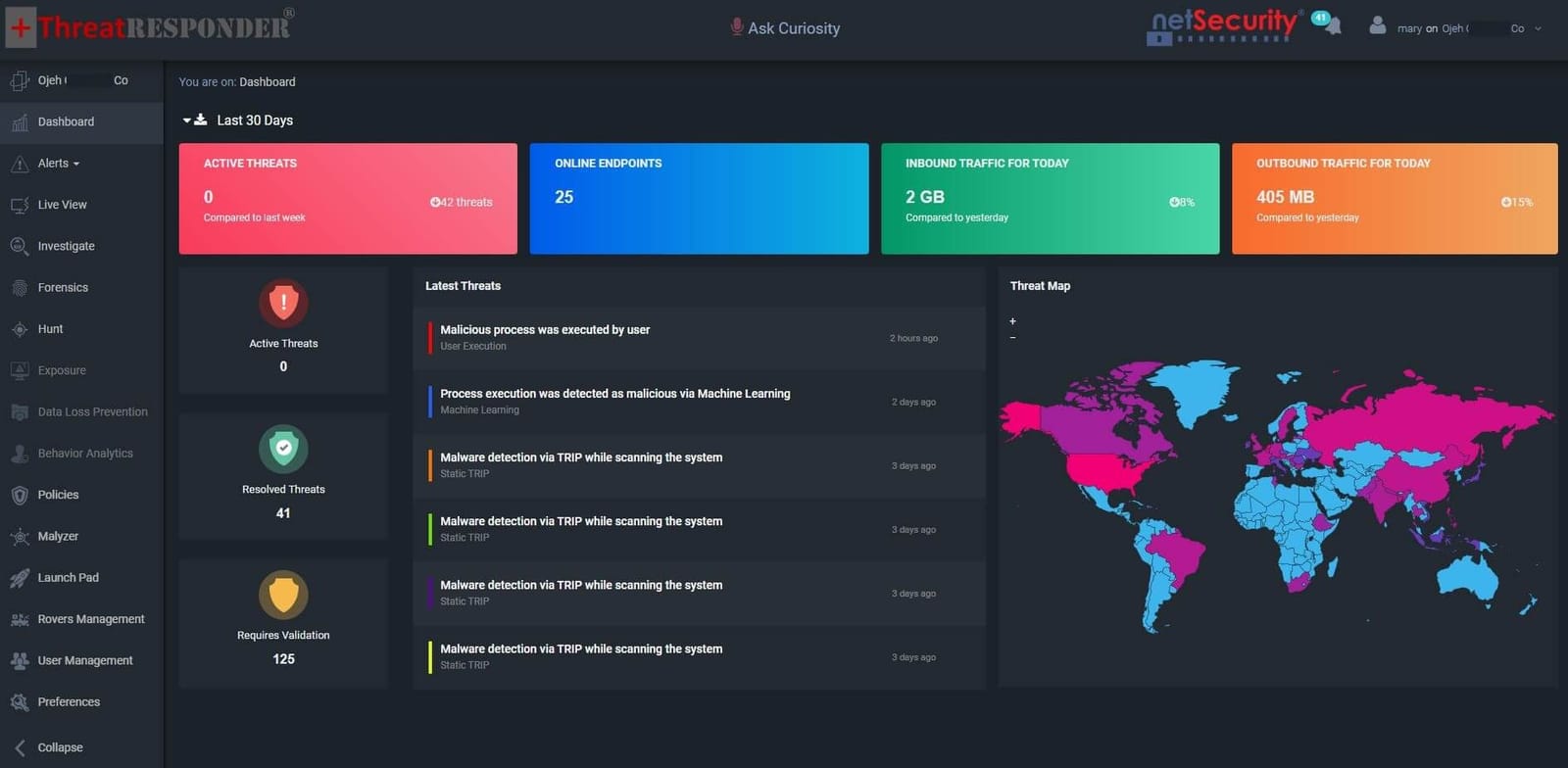
As vulnerability discovery accelerates, the ability to detect and respond to exploitation attempts becomes the most important control. NetSecurity’s ThreatResponder identifies threats in real time by correlating identity activity, endpoint behavior, cloud control plane events, and operational signals into a unified view. Instead of relying on knowledge of specific vulnerabilities, ThreatResponder focuses on how attackers behave once they attempt to exploit them.
In a world shaped by Mythos and similar frontier models, resilience depends on speed, visibility, and coordinated response. ThreatResponder helps organizations detect the unknown, respond before impact escalates, and maintain control even when the vulnerabilities themselves are not yet understood.
Disclaimer
The page’s content shall be deemed proprietary and privileged information of NETSECURITY CORPORATION. It shall be noted that NETSECURITY CORPORATION copyrights the contents of this page. Any violation/misuse/unauthorized use of this content “as is” or “modified” shall be considered illegal and subjected to articles and provisions that have been stipulated in the General Data Protection Regulation (GDPR) and Personal Data Protection Law (PDPL).