
Insider Threat in a Passwordless World: New Blind Spots Enterprises Aren’t Ready For
Passwordless authentication is a breakthrough for phishing resistance and user experience. Passkeys, FIDO2 security keys, Windows Hello, platform authenticators, and WebAuthn flows eliminate shared secrets and dramatically reduce credential phishing. Yet removing passwords does not remove insider risk. It changes where the risk hides. In a passwordless world the path to compromise shifts from guessing or stealing a password to exploiting recovery paths, session artifacts, device trust, identity governance, and application permissions. If your security strategy assumes that phishing resistant authentication equals insider safety your program will miss the new blind spots that insiders and external adversaries using compromised identities can exploit.
This article explains what changes with passwordless, why insider threat remains, the specific blind spots most organizations overlook, and how to design identity first monitoring and response to close the gaps. It concludes with a practical checklist and how ThreatResponder helps you operationalize insider threat detection when passwords are no longer the weakest link.
Why insider threat persists after passwordless
Insider risk has always included four categories: malicious insiders, negligent insiders, compromised insiders, and third party insiders. Passwordless improves initial authentication integrity but all four categories still exist because insiders already hold legitimate access. They do not need to phish themselves. They only need to misuse the access they already have or abuse the trust relationships your environment grants them. Compromised insiders also remain because attackers aim at the layers surrounding passwordless like device compromise, session theft, recovery mechanisms, SSO misconfiguration, and OAuth grants.
The misconception that authentication equals authorization
Passwordless verifies that the user can present a valid authenticator at a given moment. It does not verify that the action they take is appropriate. If an engineer uses a passkey to sign into a code repository and exfiltrates source code that is an authorized but malicious action. The control that matters at that moment is authorization and data governance, not authentication.
The rise of session and token attacks
With strong phishing resistance at login, attackers target post authentication artifacts. Browser cookies, tokens, device bound keys, refresh tokens, and session storage become high value. Malware, memory scraping, and browser extensions can hijack a session without breaking the authenticator. Insiders on trusted devices are especially difficult to distinguish from normal activity unless behavior baselines and context aware detections are in place.
New blind spots created by passwordless adoption
Passwordless changes the threat model in concrete ways. Below are the blind spots that appear most often in real environments.
Enrollment and recovery abuse
Passwordless enrollment is powerful and risky. If enrollment or recovery flows are loosely governed a malicious or compromised insider can register a new authenticator for an account they control or for a shared service identity. Common pitfalls include weak proofing during self service enrollment, recovery options that fall back to insecure channels, and inadequate approvals for adding additional authenticators to privileged accounts.
What to do:
- Require step up verification and workflow approvals for adding or recovering authenticators on high value accounts.
- Record device attestation and tie authenticators to managed devices wherever possible.
- Alert on authenticator additions outside normal change windows.
Fallback authentication and exception handling
Most enterprises keep fallback methods active for edge cases and legacy systems. SMS backups, email links, temporary codes, helpdesk override codes, break glass accounts, and legacy password prompts create back doors. Malicious insiders know these flows and can exploit social familiarity to push exceptions through.
What to do:
- Minimize fallback methods and time bound overrides.
- Segregate helpdesk privileges and require dual control for overrides on privileged identities.
- Monitor all uses of break glass and produce daily executive reports for transparency.
Device trust and shared endpoints
Passwordless often assumes that device posture is trustworthy. Insiders share laptops, use personal devices, or operate on privileged workstations that run administrative tools. If those devices are compromised or policy drift occurs, session integrity erodes. In labs, jump boxes, or call centers, shared devices can create non attributable activity.
What to do:
- Bind authenticators to compliant devices with attestation.
- Enforce conditional access based on device health and ownership.
- Instrument privileged workstations with heightened telemetry and session recording.
Token and session lifetime oversights
Passwordless does not eliminate long lived refresh tokens or persistent sessions. Default lifetimes are often generous. An insider can authenticate once and continue operating for days. If an attacker compromises a device, they inherit that persistence.
What to do:
- Shorten refresh token lifetimes for high sensitivity applications.
- Require reauthentication for privilege elevation and sensitive operations.
- Monitor for token replay across geographies or device fingerprints.
OAuth sprawl and consent abuse
Passwordless is frequently combined with SSO and OAuth for app to app access. Insider risk grows when users can grant broad scopes to third party apps or when service principals hold excessive permissions. OAuth grants can become stealthy persistence that survives authenticator rotation.
What to do:
- Restrict user consent to vetted apps and pre approved scopes.
- Continuously inventory and risk rank OAuth grants and service principals.
- Alert on new high privilege grants and on dormant apps that suddenly become active.
Passkey synchronization trust
Platform passkeys may sync through vendor ecosystems for usability. That sync layer becomes part of your trust boundary. If personal and corporate contexts mix, an employee departure or device sale can create residual access.
What to do:
- Prefer enterprise managed passkeys bound to corporate identities and devices.
- Define wipe and revocation procedures that invalidate synced passkeys on employment changes.
- Audit for authenticator reuse across personal and corporate contexts.
Biometric misperceptions
Biometrics unlock the authenticator. They do not prove intent. A coerced insider can be forced to present a fingerprint or face. A negligent insider can approve an action without reading the prompt. Overreliance on biometrics as an intent signal creates blind spots.
What to do:
- Treat biometrics as a convenience factor, not a risk reducer by itself.
- Pair sensitive operations with explicit step up verification that includes context prompts and justifications.
- Capture and log intent fields for high risk workflows.
Administrator bypass paths
Identity and access administrators can alter policies, register authenticators, issue temporary tokens, and impersonate users for troubleshooting. These are necessary powers that also create insider risk.
What to do:
- Implement just in time admin access with strong approvals and session recording.
- Separate roles for identity policy, authenticator enrollment, and incident support.
- Alert on admin actions that change authentication factors or bypass policy for protected roles.
Insider scenarios specific to passwordless environments
Understanding how insiders actually operate helps you design concrete controls.
Scenario 1: Quiet exfiltration with legitimate sessions
A developer uses a passkey to log into a code platform, clones several private repositories after hours, and pushes archives to a personal cloud account. There is no failed login and no malware. The only signals are timing, volume, and unusual destinations.
Controls to apply:
- Baseline typical repository access per identity and project.
- Trigger alerts on off hours bulk clones or atypical repository combinations.
- Inspect outbound destinations and enforce DLP with identity context.
Scenario 2: OAuth persistence after departure
A marketing manager grants a third party analytics tool access to a wide set of documents and mailboxes. Months later they leave the company, but the app’s service principal retains access and begins exporting large volumes of files.
Controls to apply:
- Include OAuth grants in offboarding workflows.
- Continuously verify app usage and revoke inactive or over privileged grants.
- Require admin consent for scopes that include mailbox or drive export.
Scenario 3: Helpdesk assisted authenticator swap
An employee calls the helpdesk to report a lost device and requests a new authenticator registration. A malicious insider in the helpdesk approves without second level verification. The caller now has two authenticators and uses the new one to operate from an unmanaged personal laptop.
Controls to apply:
- Enforce two person approval for authenticator changes on protected accounts.
- Require device attestation for new authenticator registrations.
- Alert on authenticator changes followed by access from unmanaged devices.
Scenario 4: Token theft on a privileged workstation
A systems engineer with broad rights uses a browser on a jump host to manage cloud resources. Malware on the host exfiltrates session tokens. An external attacker uses the tokens to perform destructive actions that appear as the engineer’s identity.
Controls to apply:
- Lock down browser extension installation and disable risky flags on admin hosts.
- Shorten token lifetimes and bind tokens to device context.
- Require step up verification for destructive cloud operations even within an existing session.
Detection and response for passwordless insider risk
With passwords gone the SOC must pivot to identity centric analytics and response. The goal is to identify misuse of legitimate access quickly and take action that removes access and reduces blast radius without breaking business operations.
Build an identity first telemetry foundation
Collect and correlate:
- Authenticator lifecycle events including additions, recoveries, and deletions.
- Session metadata such as device ID, attestation results, token issuance, and token lifetime.
- OAuth and service principal grants and scope changes.
- Privilege elevation, admin role activation, and policy edits.
- Application specific high risk actions such as export, share, delete, or permission change.
Baseline behavior for users, roles, and machines
Focus on:
- Typical access patterns for applications and data repositories.
- Normal working hours and geographic or network context per identity.
- Expected relationships between roles and actions, for example developers and code repositories, finance and ERP exports, admins and policy edits.
Correlate identity, endpoint, and data movement
Identity telemetry alone can look benign. Correlate identity events with:
- Endpoint signals such as process launches tied to bulk file operations.
- Data access anomalies like unusual query patterns or mass download.
- Network egress to atypical destinations or newly observed domains.
Respond with identity aware actions
When insider misuse is suspected:
- Revoke active sessions and refresh tokens for the identity.
- Temporarily disable high risk grants and service principals.
- Require step up verification for subsequent access during investigation.
- Isolate devices only if endpoint compromise is suspected to avoid unnecessary disruption.
Investigate intent and scope
Determine whether the activity is malicious or negligent by examining:
- Sequence of actions surrounding the event.
- Prior history of similar behavior.
- Peer comparisons and role expectations.
- Explanations provided by the user and corroborating ticket history.
Governance and architecture moves that reduce blind spots
You cannot log your way out of design flaws. Reduce insider exposure by shaping identity architecture.
Minimize standing privilege with just in time access
Grant privileged roles only when needed and for a short duration. Require approvals and context for activation. Record sessions and automatically expire elevation.
Constrain OAuth and app permissions
Only allow pre approved enterprise applications with least privilege scopes. Periodically re certify high privilege grants with business owner sign off.
Make device trust explicit
Bind authenticators to managed devices with attestation and enforce conditional access for app categories. Separate personal and corporate contexts cleanly on BYOD with app level controls.
Harden fallback and break glass
Design break glass accounts with severe restrictions, strict monitoring, and tested procedures. Eliminate SMS and email fallback for privileged users and replace with secure recovery staffed by multiple approvers.
Engineer crypto and token hygiene
Adopt shorter token lifetimes and device bound tokens where supported. Rotate tokens and keys aggressively on role changes and offboarding. Validate that refresh token revocation works at scale.
Metrics CISOs should track for passwordless insider readiness
- Time to detect and contain suspicious identity activity.
- Percent of privileged accounts with just in time access vs standing admin.
- Number of authenticator changes on protected accounts per month and approval compliance.
- OAuth grant inventory growth, high privilege grant count, and re certification completion.
- Token lifetime distributions and percentage of device bound tokens.
- Break glass usage frequency and time to report and review each event.
A practical 90 day plan to close passwordless insider gaps
- Weeks 1 to 3: Inventory authenticators, fallback methods, OAuth grants, and privileged identities. Define protected roles and sensitive operations.
- Weeks 4 to 6: Implement approvals for authenticator changes on protected roles. Restrict user consent and enforce admin consent for high scopes. Shorten token lifetimes for sensitive apps.
- Weeks 7 to 9: Deploy behavior analytics for bulk data movement, off hours access, and privilege elevation sequences. Integrate identity, endpoint, and data telemetry into unified investigations.
- Weeks 10 to 12: Pilot just in time admin for a high value team. Lock down break glass and add mandatory post use reviews. Run a tabletop on authenticator recovery abuse and token theft on a privileged host.
How ThreatResponder helps in a passwordless enterprise
Passwordless reduces phishing but increases the need for identity centric detection and fast, precise response. ThreatResponder helps teams close the new blind spots.
Unified identity narrative
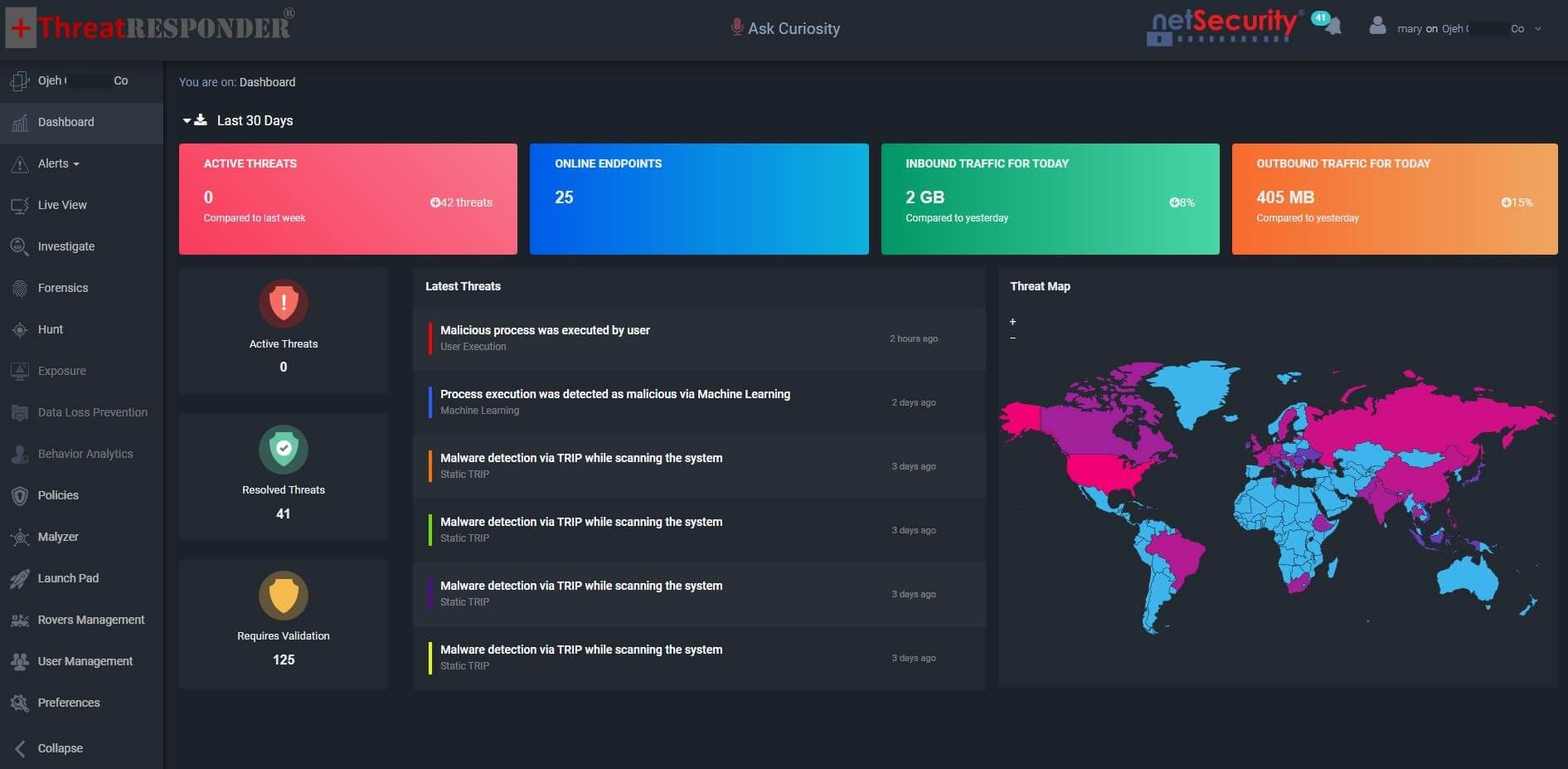
ThreatResponder correlates authenticator lifecycle events, session metadata, OAuth grants, and application actions with endpoint and data movement signals. Analysts see a single narrative of what the identity did, on which device, and with what effect.
Early detection of insider misuse
Behavioral analytics surface suspicious sequences like authenticator changes followed by access from unmanaged devices, off hours bulk export after privilege elevation, or sudden creation of high privilege OAuth grants.
Rapid, controlled identity response
ThreatResponder enables revoking sessions, disabling risky grants, and enforcing step up verification in minutes while recording actions for audit. Response playbooks are tuned to reduce business disruption while cutting off attacker momentum.
Reduced analyst load
By turning fragmented identity and activity data into prioritized, context rich incidents, ThreatResponder helps teams focus on the few identity events that matter and resolve them quickly.
Passwordless is progress. It removes a major class of attacks and improves user experience. It does not remove insider threat. The organizations that will thrive in a passwordless world are those that treat identity as the operational perimeter, build behavior centric detections, harden recovery and fallback paths, and respond at the identity layer with speed and precision. ThreatResponder is built to help you make that shift so insiders and compromised insiders cannot turn strong authentication into a false sense of security.
Disclaimer
The page’s content shall be deemed proprietary and privileged information of NETSECURITY CORPORATION. It shall be noted that NETSECURITY CORPORATION copyrights the contents of this page. Any violation/misuse/unauthorized use of this content “as is” or “modified” shall be considered illegal and subjected to articles and provisions that have been stipulated in the General Data Protection Regulation (GDPR) and Personal Data Protection Law (PDPL).