What CISOs Get Wrong About OT Cyber Risk
Operational Technology cyber risk continues to be misunderstood, underestimated, or oversimplified at the CISO level. Many security leaders come from IT-first backgrounds where threats are measured by data loss, financial impact, or regulatory exposure. OT environments do not follow the same rules. They are built for availability, safety, and physical process continuity. When CISOs apply traditional IT security thinking to OT, blind spots emerge that attackers exploit.
OT cyber incidents rarely start with dramatic controller manipulation or unsafe process states. They begin with overlooked access paths, identity misuse, weak segmentation, and assumptions that OT is isolated or too specialized to be targeted. These assumptions are no longer valid. OT systems are connected, monitored remotely, integrated with enterprise IT, and increasingly exposed through vendors and cloud services.
This blog breaks down the most common mistakes CISOs make about OT cyber risk, why those assumptions fail in real incidents, and what a more accurate risk model looks like.
Mistake one: believing OT is air-gapped or isolated
Why the air-gap assumption no longer holds
One of the most persistent misconceptions is that OT networks are isolated from external threats. In reality, modern OT environments are connected in multiple ways:
- Remote vendor access for maintenance and troubleshooting
- Centralized monitoring and data historians connected to IT
- Engineering workstations joined to enterprise domains
- VPNs and jump hosts bridging IT and OT
- Cloud-based analytics and management platforms
Even when OT systems are not directly internet-facing, the paths into them are often indirect. Attackers do not need to breach a PLC to cause operational disruption. Compromising an engineer’s credentials or a remote access server can be enough.
How attackers exploit this misconception
Threat actors frequently start in IT environments where defenses are weaker or more familiar. From there, they pivot toward OT-adjacent systems that operators rely on for visibility and control. The assumption of isolation delays detection because early activity appears unrelated to “real OT systems.” By the time the impact is visible, the attacker has already mapped dependencies and identified leverage points.
Mistake two: focusing only on catastrophic safety scenarios
Not every OT attack aims for physical damage
Many CISOs evaluate OT risk primarily through worst-case safety scenarios. While safety is critical, most real-world attacks aim for disruption rather than destruction. Attackers often avoid actions that could cause physical harm because those actions trigger immediate and overwhelming response.
Instead, they target:
- Loss of visibility through HMI or historian disruption
- Forced shutdowns due to uncertainty
- Manual operation modes that slow throughput
- Alarm fatigue and operator overload
- Regulatory and public trust pressure
These outcomes are easier to achieve and still deliver significant impact.
Why disruption is often the preferred objective
Disruption creates uncertainty without crossing safety thresholds. Operators may choose to halt operations out of caution. Leadership may face regulatory scrutiny. Customers and the public experience service instability. All of this happens without touching safety systems directly. CISOs who only plan for catastrophic sabotage miss the far more common and realistic disruption scenarios.
Mistake three: treating OT as a purely technical problem
OT cyber risk is operational risk
OT security is not just about firewalls, sensors, or asset inventories. It is about how technology supports physical processes and human decision-making. Many incidents escalate because operators do not trust what they see or cannot see enough to make safe decisions.
If security controls disrupt operations or are poorly understood by OT staff, they can increase risk instead of reducing it. This is why purely technical security projects often fail to improve real resilience.
Where governance breaks down
CISOs often struggle with OT because ownership is fragmented. IT owns networks and identity. OT owns processes and safety. Engineering owns systems. Vendors own updates and access. Without clear governance, security decisions stall or get diluted.
Attackers benefit from this ambiguity. They exploit gaps between teams, assumptions about responsibility, and delays caused by coordination challenges.
Mistake four: underestimating identity risk in OT environments
Identity is the fastest path to disruption
Many OT incidents begin with compromised credentials. Engineers, contractors, vendors, and operators often share access across systems and sites. Password reuse, weak MFA, and long-lived accounts are common due to operational convenience.
Once attackers gain valid credentials, they can:
- Access remote management tools
- Modify configurations
- Disable monitoring
- Disrupt remote access services
- Move laterally between IT and OT-adjacent systems
This often looks like legitimate activity, which delays response.
Why identity controls lag in OT
OT environments are sensitive to change. CISOs are often hesitant to enforce stronger authentication or privilege controls out of fear of operational disruption. As a result, identity becomes the weakest link.
Strong identity controls do not require redesigning OT systems. They require protecting the access paths around them. Phishing-resistant MFA, time-bound privileges, and monitoring for anomalous access patterns dramatically reduce risk without touching controllers.
Mistake five: assuming attackers need deep OT expertise
Most attacks succeed without process manipulation
A common belief is that OT attacks require deep knowledge of industrial protocols and physical processes. While that knowledge exists among some threat actors, most successful incidents do not require it.
Attackers focus on:
- Windows systems that support OT operations
- Backup servers and configuration repositories
- Network infrastructure and remote access gateways
- Identity platforms and credential stores
By disrupting these components, they indirectly disrupt operations.
Why this lowers the barrier to entry
This approach allows a wide range of attackers to target OT environments, including financially motivated groups and opportunistic actors. CISOs who assume only highly specialized adversaries pose risk underestimate the threat landscape.
Mistake six: overestimating visibility into OT environments
Asset inventories are often incomplete
Many organizations believe they have adequate visibility into their OT assets. In practice, inventories are outdated, manually maintained, or limited to specific segments. Shadow assets, legacy devices, and temporary connections are common.
Attackers use scanning and passive discovery to find exposed systems faster than defenders can document them.
Monitoring gaps delay detection
OT monitoring is often focused on availability and performance, not security behavior. Security teams may lack visibility into:
- Authentication events for OT access
- Configuration changes on critical systems
- Lateral movement between zones
- Abnormal protocol usage
This means early indicators of compromise are missed, allowing attackers to prepare disruption without detection.
Mistake seven: believing segmentation alone solves OT risk
Segmentation must reflect operational reality
Network segmentation is essential, but it is not a silver bullet. Many segmented environments still allow broad access through jump hosts, shared credentials, or trusted pathways. If segmentation is designed for diagrams rather than workflows, attackers will find the gaps.
Effective segmentation asks practical questions:
- What systems must talk to each other to keep operations safe?
- What access can be temporarily disabled during escalation?
- What paths exist for vendors and emergency support?
Why attackers still move laterally
Attackers look for choke points where segmentation collapses under operational pressure. Shared admin accounts, dual-homed systems, and convenience-based exceptions are common. Without monitoring and enforcement, segmentation becomes theoretical rather than protective.
Mistake eight: neglecting recovery as part of OT security
Recovery determines resilience
Many CISOs focus heavily on prevention and detection while assuming recovery will work when needed. In OT environments, recovery is complex. Systems may require vendor support, specialized hardware, or precise configurations. Backups may exist but be untested or inaccessible during an incident.
Attackers increasingly target backups, configuration files, and recovery infrastructure because they know recovery speed determines business impact.
Why OT recovery fails in practice
Common failure points include:
- Backup systems using the same credentials as production
- Lack of clean baseline images
- Unclear restoration order across dependencies
- Inability to validate integrity before restoration
- Limited staffing during prolonged incidents
Recovery planning must assume hostile conditions, not ideal ones.
Mistake nine: ignoring the messaging impact of OT incidents
OT disruption is public by default
When critical services are affected, the impact is immediately visible. Water advisories, power interruptions, production shutdowns, and transportation delays attract attention. Attackers know this and design campaigns to maximize visibility.
CISOs who treat OT incidents as internal technical issues underestimate the reputational and strategic impact.
Why communication is part of OT cyber defense
Prepared communication reduces panic and misinformation. Clear messaging helps maintain trust while response teams work. Without it, attackers control the narrative through leaks, claims, and speculation.
Communication planning should be considered an operational control, not an afterthought.
Mistake ten: waiting for certainty before acting
Attribution delays response
OT incidents often begin ambiguously. CISOs may hesitate to escalate without clear attribution or confirmation of intent. Attackers exploit this hesitation. They use slow, low-noise techniques to stay below response thresholds until they are ready to disrupt.
The correct question is not “who is behind this?” but “what operational risk does this create right now?”
Why speed matters more than precision
Early containment, access restriction, and validation of recovery paths reduce impact even if attribution is incomplete. Waiting for perfect information gives attackers time to prepare and execute disruption.
What CISOs should get right about OT cyber risk
OT risk is about continuity, not just compromise
The goal of OT security is to maintain safe and reliable operations under stress. This requires aligning security controls with operational realities and human decision-making.
Access paths matter more than assets
Protecting controllers is important, but protecting how people and systems access those controllers is often more effective. Identity, remote access, and vendor pathways deserve priority.
Disruption is the most likely outcome
Plan for loss of visibility, forced manual operations, and degraded performance. These scenarios are more common than catastrophic sabotage and still carry significant impact.
Recovery is a primary defense
Assume systems will be disrupted. Invest in recovery engineering, clean rebuild processes, and regular testing under realistic conditions.
The path forward for CISOs
CISOs do not need to become OT engineers to manage OT cyber risk effectively. They need to ask better questions, challenge outdated assumptions, and focus on the conditions that attackers exploit most often.
When OT incidents occur, speed, coordination, and operational awareness matter more than perfect attribution or textbook controls. Security programs that integrate identity protection, exposure reduction, segmentation built for real workflows, and recovery-first thinking are better positioned to withstand disruption.
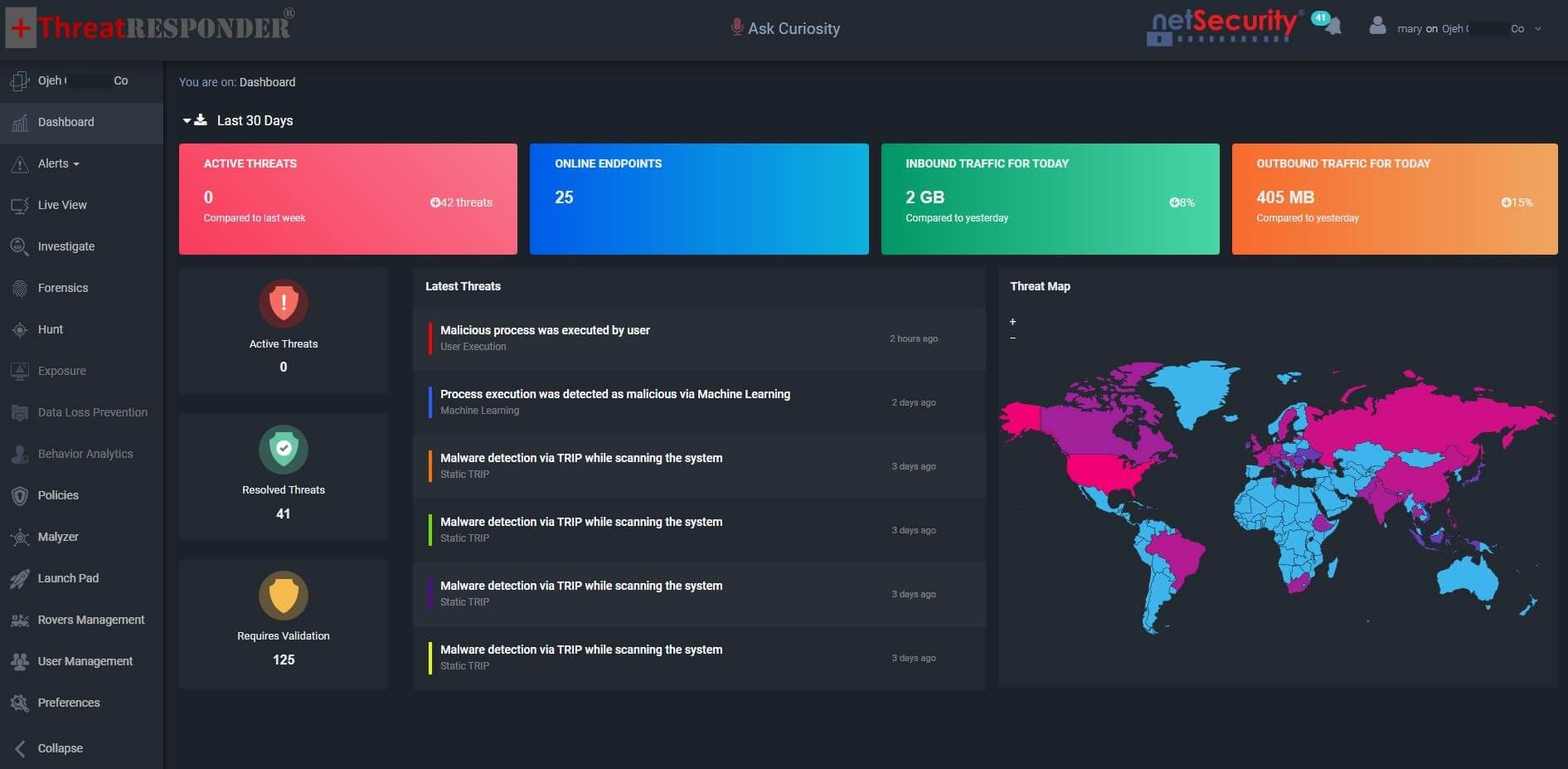
NetSecurity’s ThreatResponder strengthens OT cyber resilience by extending endpoint security into escalation-ready response. ThreatResponder delivers rapid triage, identity-aware containment, endpoint validation, and recovery-focused response that helps organizations restore operational confidence quickly when disruption targets endpoints and OT-adjacent systems.
When disruption becomes the objective, speed and structure matter. NetSecurity’s ThreatResponder helps critical infrastructure teams respond with escalation-ready triage, threat hunting, containment, OT-aware decision support, and recovery-first execution designed to restore services safely and quickly when it matters most.
Disclaimer
The page’s content shall be deemed proprietary and privileged information of NETSECURITY CORPORATION. It shall be noted that NETSECURITY CORPORATION copyrights the contents of this page. Any violation/misuse/unauthorized use of this content “as is” or “modified” shall be considered illegal and subjected to articles and provisions that have been stipulated in the General Data Protection Regulation (GDPR) and Personal Data Protection Law (PDPL).