
The Predictive Security Model Is Dead, Preemptive Security Is the Only Way Forward
The cybersecurity industry has reached a breaking point. For years, organizations invested heavily in predictive security models that promised early warning, risk scoring, and prevention before impact. Those models were built on assumptions that no longer hold true. Attackers now move at machine speed. Exploits are weaponized within hours. Credentials are traded like commodities. Artificial intelligence accelerates every stage of the attack lifecycle. In this reality, prediction is too slow and prevention based on forecasts is failing.
The predictive security model is dead. What replaces it is not another layer of dashboards or threat scores but a fundamentally different approach. Preemptive security focuses on removing attacker advantages before exploitation occurs. It prioritizes action over prediction and speed over certainty. This shift is not optional. It is the only way forward.
Why Predictive Security Once Made Sense
Predictive security emerged during a time when attackers operated slower and attacks were more linear. Vulnerability disclosures often took weeks or months to turn into reliable exploit campaigns. Security teams could prioritize patching based on severity scores, asset criticality, and known threat actor interest. Threat intelligence feeds helped anticipate which vulnerabilities or attack techniques might be used next.
Predictive models relied on historical data, pattern recognition, and assumptions about attacker behavior. Security tools attempted to forecast risk and reduce it through prioritization. In this era, security teams had enough time to predict what mattered.
That time advantage is gone.
The Collapse of the Prediction Window
The most important change in modern cyber attacks is the collapse of the prediction window. The time between vulnerability disclosure and active exploitation has shrunk dramatically. For many high impact vulnerabilities, exploitation begins before patches are widely applied and sometimes before full details are publicly available.
Attackers no longer wait for defenders.
Automation and orchestration have transformed exploitation into a race that humans cannot win using manual workflows. Exploit kits are updated within hours. Scanning for exposed systems is continuous and global. Payload deployment and lateral movement happen in minutes, not days.
Predictive security depends on analysis before action. Attackers depend on action before analysis. That mismatch is fatal.
Machine Speed Attacks Change Everything
Artificial intelligence and automation have changed the economics of cybercrime. Tasks that once required skilled operators now run autonomously. Reconnaissance, phishing generation, malware modification, and credential validation can all be automated and scaled.
Machine speed attacks remove friction from the attacker lifecycle. A single credential leak can be validated, weaponized, and monetized across thousands of environments in a short time window. Initial access brokers thrive in this environment, selling verified access faster than defenders can respond.
Predictive models cannot keep up because they are not designed for zero dwell time attacks. When compromise and impact occur almost simultaneously, prediction becomes irrelevant.
Identity Has Replaced Vulnerabilities as the Primary Entry Point
Predictive security historically focused on vulnerabilities. While vulnerabilities remain important, identity has become the dominant attack vector. Stolen credentials, session tokens, and OAuth grants enable attackers to bypass traditional defenses entirely.
Infostealer malware feeds underground marketplaces with fresh credentials every day. These credentials often have multi factor authentication bypass opportunities through token reuse or trusted device abuse. Predictive scoring of vulnerabilities offers little protection when attackers sign in using valid credentials.
Preemptive security addresses this reality by focusing on identity hardening, continuous access validation, and rapid credential revocation. Prediction cannot protect what is already valid.
The Illusion of Risk Scores
Risk scoring is one of the most harmful legacies of predictive security. Vulnerability scores, exploit likelihood ratings, and threat scores create a false sense of control. They suggest that risk can be neatly ranked and managed through prioritization.
In practice, attackers do not care about scores. They care about exposure and opportunity. A medium severity issue with wide exposure and weak monitoring may be exploited before a critical vulnerability buried behind strong controls.
Preemptive security removes the illusion of perfect ranking and focuses on reducing exposure universally. It emphasizes closing common paths attackers rely on instead of guessing which path they will take.
What Preemptive Security Really Means
Preemptive security does not attempt to predict the future. It assumes compromise is always possible and removes attacker leverage before it can be abused. It is proactive rather than reactive and operational rather than analytical.
At its core, preemptive security answers one question. What conditions do attackers need to succeed, and how do we remove them now?
Preemptive Control of Exposure
Exposure is the foundation of most attacks. Internet facing services, stale credentials, excessive privileges, and unmonitored integrations create opportunity. Preemptive security aggressively reduces exposure by default.
This includes removing unused accounts, limiting external access, enforcing least privilege relentlessly, and eliminating unnecessary attack surface. Waiting for a prediction that something will be exploited wastes time.
Continuous Credential Hygiene
Preemptive security treats credentials as perishable. Passwords, tokens, API keys, and secrets are rotated frequently and automatically. Compromised credentials are assumed to exist somewhere and steps are taken to reduce their usefulness.
This approach recognizes that credential theft cannot be fully prevented. What matters is limiting how long stolen access remains valid.
Identity First Detection
Instead of waiting for suspicious behavior patterns, preemptive security focuses on identity context. Changes in authentication patterns, privilege use, and session behavior trigger immediate containment.
This allows defenders to interrupt attacks earlier in the lifecycle before lateral movement or data exfiltration occurs.
Kill Chain Disruption Over Alerting
Predictive models generate alerts and hope humans will respond in time. Preemptive security focuses on disruption. Automated actions block suspicious access, isolate identities, and restrict movement without waiting for full investigation.
Speed matters more than confidence during early stages of an attack. Preemptive controls can be relaxed later if activity is deemed benign.
Why Preemptive Security Scales Better Than Prediction
Organizations continue to grow their environments. Cloud adoption, SaaS sprawl, and developer velocity increase complexity every year. Predictive security scales poorly because it relies on human interpretation and prioritization.
Preemptive security scales through policy and automation. Guardrails replace guesswork. Controls enforce security outcomes regardless of size or speed.
By eliminating entire classes of attacker behavior through design, defenders reduce cognitive load and dependency on perfect intelligence.
The Cultural Shift Security Teams Must Make
Moving to preemptive security requires more than new tools. It requires a mindset shift.
Security teams must let go of the comfort of forecasts and accept a more adversarial reality. They must prioritize preventing damage over predicting intent. This often means accepting a higher rate of automated actions and fewer explanations upfront.
Leadership must support this shift by measuring success differently. Mean time to contain and exposure reduction matter more than alert counts or prediction accuracy.
The Cost of Staying Predictive
Organizations that cling to predictive security face increasing risk. Delayed response, over reliance on scores, and fragmented visibility create blind spots attackers exploit easily.
Every major breach reinforces the same lesson. Attackers move faster than prediction allows. Waiting for indicators wastes opportunity to act.
Preemptive security reduces blast radius even when detection fails. Prediction offers no such guarantee.
Security Operations in the Preemptive Era
Security operations evolve under a preemptive model. Playbooks become automated responses rather than investigation guides. Detection engineering focuses on early choke points instead of complex correlations.
Threat intelligence is still valuable but it informs posture decisions rather than predictions. Intelligence helps refine controls instead of dictating reaction timelines.
Preemptive security turns security operations from observers into active participants in attack disruption.
Why This Shift Is Inevitable
The evolution of cyber threats shows no sign of slowing. Automation, artificial intelligence, and commoditized access continue to favor attackers. Defensive strategies built on anticipation will continue to fail.
Preemptive security aligns defense with reality. It accepts uncertainty, prioritizes speed, and removes advantage before attackers can use it.
This is not pessimism. It is strategic realism.
The Future Belongs to Preemptive Defenders
Organizations that adopt preemptive security gain resilience. They may still experience threats, but impact is limited. Operations remain functional. Recovery is faster. Confidence improves.
Security stops being a reactive function and becomes a continuous enforcement of safe operating conditions.
The predictive security model had its moment. That moment has passed.
Preemptive security is not the future. It is the present.
Preemptive Defenders Use NetSecurity ThreatResponder
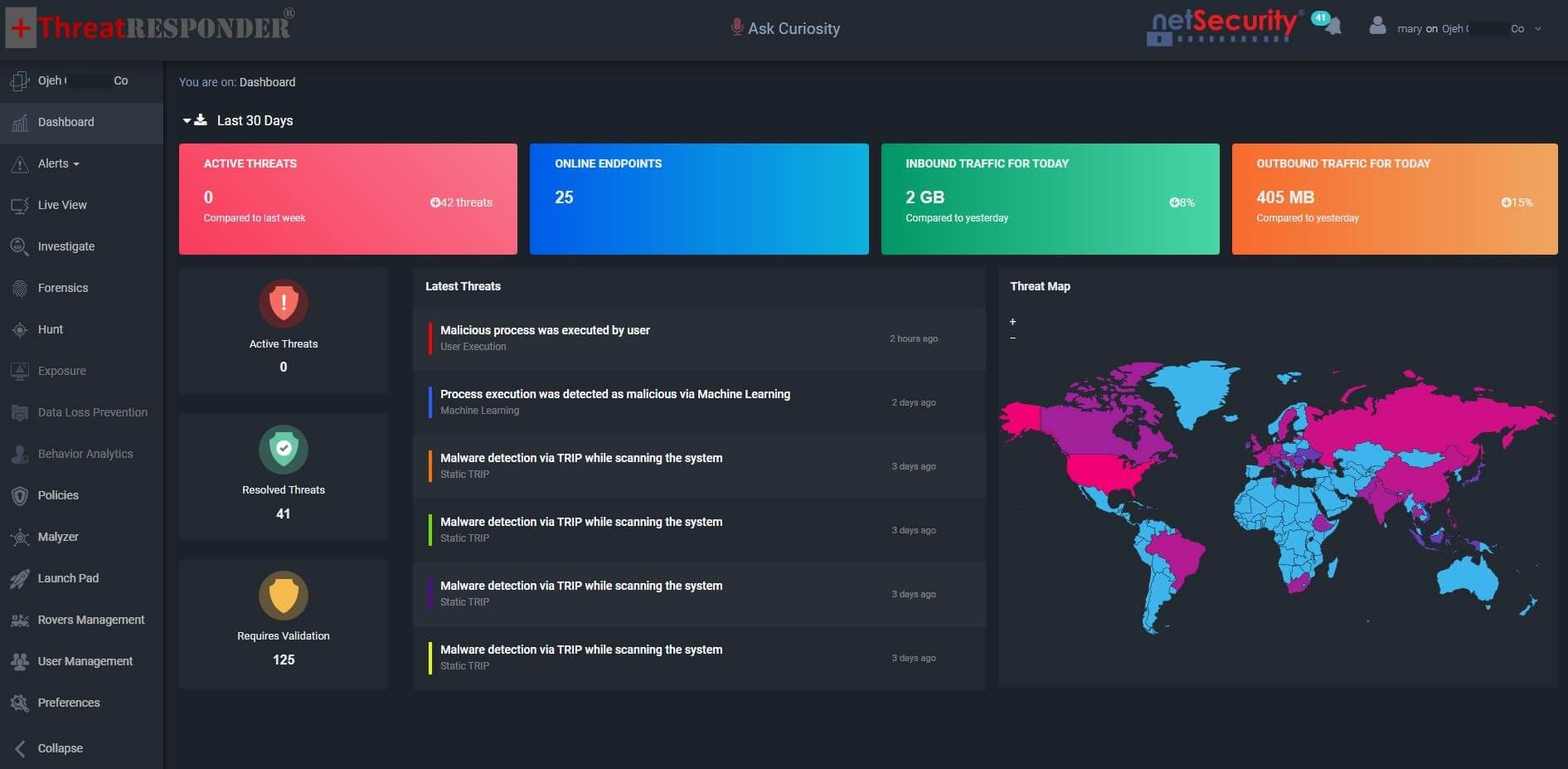
As cyber attacks continue to accelerate, organizations need security platforms that enable preemptive action at machine speed. NetSecurity ThreatResponder is built for this new reality. By focusing on exposure reduction, identity protection, rapid containment, and automated response, ThreatResponder helps security teams disrupt attacks before damage occurs. Prediction alone no longer protects modern environments. Preemptive security does. NetSecurity ThreatResponder delivers it.
Disclaimer
The page’s content shall be deemed proprietary and privileged information of NETSECURITY CORPORATION. It shall be noted that NETSECURITY CORPORATION copyrights the contents of this page. Any violation/misuse/unauthorized use of this content “as is” or “modified” shall be considered illegal and subjected to articles and provisions that have been stipulated in the General Data Protection Regulation (GDPR) and Personal Data Protection Law (PDPL).