Ransomware After the Fragmentation Era: Why Smaller Gangs Are Now More Dangerous
For years, many organizations framed ransomware as a problem of big names. A few dominant groups, a handful of infamous leak sites, and a predictable cycle of encrypt, extort, and move on. That mental model is now outdated. Ransomware has entered the fragmentation era, where smaller gangs, affiliate splinters, and short-lived brands create a threat environment that is more volatile, more opportunistic, and in many ways more dangerous than the era of large centralized cartels.
The ransomware landscape has changed, and it is not getting safer
Fragmentation does not mean ransomware is weakening. It means it is becoming more resilient. When a large group disappears, the talent, tooling, and access brokers do not vanish. They disperse. They rebrand. They join new crews. They form temporary partnerships. They compete aggressively for victims. The result is a ransomware ecosystem that is harder to track, harder to predict, and harder to disrupt.
This shift matters for CISOs, security leaders, and SOC teams because it changes how attacks unfold, how risk should be measured, and how defense should be designed. In a fragmented world, you cannot rely on tracking a few big actors or blocking a few known infrastructures. You must defend against a high volume of fast-moving operations that use common playbooks but vary just enough to slip past traditional detection.
This article explains why smaller gangs have become more dangerous, how their operating model works, what new patterns defenders should watch for, and how to build a response strategy that reduces business impact. It closes with a practical section on how ThreatResponder helps organizations detect and stop ransomware earlier in the attack chain.
What “fragmentation” really means in modern ransomware
Fragmentation is not just a trend. It is an operating condition. It describes an ecosystem where ransomware capabilities are distributed across specialists rather than concentrated in one stable organization.
In the fragmentation era, ransomware operations often consist of:
- Initial access brokers who sell stolen credentials, VPN access, or footholds.
- Affiliates who deploy ransomware payloads and run intrusions.
- Developers who maintain encryption tools and leak site infrastructure.
- Negotiators who handle extortion communications and payment logistics.
- Data theft crews who specialize in exfiltration and staging.
- Monetization partners who handle laundering and off-ramp processes.
This division of labor lowers the barrier to entry for attackers. Smaller gangs can assemble capabilities quickly without building everything from scratch. A short-lived crew can still conduct high-impact attacks if it buys access and uses proven tooling. That is why defender focus must shift from “who is the group” to “how the intrusion behaves.”
Why smaller gangs thrive in this environment
Smaller gangs thrive because fragmentation creates speed and flexibility:
- They can pivot quickly when security vendors publish detections.
- They can swap tools and infrastructure without bureaucratic overhead.
- They can target mid-market organizations that may have weaker controls.
- They can exploit niche gaps like unmanaged SaaS, legacy VPNs, or exposed RDP.
- They can adapt extortion tactics to maximize pressure per victim.
This makes them dangerous, not because they are more sophisticated individually, but because the ecosystem makes sophistication accessible.
Why smaller ransomware gangs are now more dangerous than big brands
Security teams used to benefit from a few stable dynamics: big groups needed reputation, consistency, and recognizable infrastructure to pressure victims and recruit affiliates. Fragmentation breaks those dynamics and introduces new risks.
1) Higher volume of attacks with shorter dwell time
Smaller crews often operate with a “hit fast” mindset. They do not need long reconnaissance cycles. They rely on pre-built playbooks: steal credentials, disable defenses, identify backups, exfiltrate key data, then execute ransomware quickly.
Shorter dwell time reduces defender opportunity. If your organization measures success by how quickly you detect the encryption event, you are already too late. In the fragmentation era, the window for prevention is earlier: initial access, identity misuse, privilege escalation, and lateral movement.
2) More opportunistic targeting and less predictable victimology
Large groups often had target preferences and negotiation norms. Smaller gangs are less predictable. Some prioritize rapid payouts over brand reputation. Some target niche sectors. Some will attack the same organization twice if they find a second access path. Others will exploit a supply chain foothold and expand quickly.
This unpredictability increases the value of detection programs that focus on behaviors rather than threat actor naming.
3) Extortion tactics are diversifying beyond encryption
Encryption is only one lever. Many smaller gangs can still cause severe business impact through data theft and coercion, even if encryption fails. In some cases, attackers use extortion-only operations: steal data, threaten disclosure, and apply pressure without encrypting systems. This reduces their operational complexity and lowers their risk of detection during large-scale encryption deployment.
Defenders must assume data theft is part of the default ransomware playbook, not an optional add-on.
4) Tooling reuse increases, but it is used more creatively
Fragmentation increases reuse of common tools: remote management software, credential dumpers, scripting frameworks, and cloud APIs. That might sound like a defender advantage, but agent-like operators can rotate and combine tools creatively. They can use legitimate admin utilities and “living off the land” techniques to blend in.
The most dangerous part is not the ransomware binary. It is the intrusion chain that leads to it.
5) Disruption and takedowns have less lasting impact
When a major brand collapses, defenders often expect a temporary lull. In a fragmented ecosystem, disruption creates churn, not relief. Affiliates migrate. New names appear. Tooling evolves. The same intrusion methods continue with minor changes.
That is why “threat actor tracking” cannot be your primary defense plan. It should support intelligence and prioritization, but it cannot replace resilient detection and response.
The modern ransomware kill chain: what actually happens before encryption
To stop ransomware in a fragmented era, you need to detect earlier than encryption. The most consistent early indicators are tied to identity and operational control.
Stage 1: Initial access through credentials, misconfigurations, or exposed services
Common entry paths include stolen credentials, weak MFA coverage, exposed remote services, and misconfigured cloud access. Attackers increasingly value access that appears legitimate because it reduces the need for malware-heavy delivery.
What to watch:
- Unusual login patterns followed by immediate access to admin consoles.
- First-time logins to sensitive apps from unmanaged devices.
- New OAuth consents or API token creation without change approvals.
Stage 2: Privilege escalation and persistence through identity and configuration
Smaller gangs often secure persistence by manipulating accounts, roles, and policies rather than installing complex backdoors. In cloud environments, creating new keys, adding roles, or modifying conditional access can be the persistence mechanism.
What to watch:
- New admin users, new service principals, or new access keys.
- Role assignments that expand quickly across projects or subscriptions.
- Security policy changes that reduce monitoring or alerting.
Stage 3: Discovery, lateral movement, and backup targeting
Ransomware crews prioritize business impact. That means they look for the systems that matter: domain controllers, file servers, backup repositories, virtualization hosts, and identity providers. They will also target EDR management consoles, monitoring stacks, and ticketing systems.
What to watch:
- Remote execution patterns that resemble IT tasks but occur at odd times.
- Large-scale enumeration of SMB shares, AD objects, or cloud resources.
- Access to backup management tools followed by deletion or retention changes.
Stage 4: Data staging and exfiltration
Data theft increasingly happens quietly. Attackers compress and stage data internally, then exfiltrate in chunks through standard protocols or cloud storage.
What to watch:
- Unusual archive creation on servers that do not normally compress data.
- Service-to-service transfers to unknown destinations.
- Sudden spikes in access to sensitive repositories by a single identity.
Stage 5: Encryption, disruption, and pressure operations
Encryption is often paired with operational disruption: disabling security tools, deleting snapshots, and manipulating recovery mechanisms. Some crews also use harassment tactics like mass emails, public posts, or direct outreach to partners.
What to watch:
- Security agent tampering attempts.
- Sudden changes to shadow copies, snapshots, and backup settings.
- Mass file renames and rapid write operations across multiple hosts.
Why traditional “ransomware detection” is too late
Many organizations still treat ransomware as a malware event. They wait for suspicious binaries, file encryption behavior, or endpoint alerts signaling ransomware execution. That mindset fails in a fragmentation era for three reasons:
First, the damage occurs before encryption
Data theft, backup sabotage, and identity compromise can create lasting harm even if encryption is contained. Your brand, legal exposure, and operational recovery can be impacted without a single encrypted file.
Second, encryption can be fast and distributed
Smaller gangs can deploy across many endpoints quickly using stolen admin access, scripts, and management tools. By the time encryption triggers an alert, it is already widespread.
Third, attackers increasingly use legitimate tooling
If ransomware deployment looks like “normal IT operations” until the final stage, detection must focus on suspicious intent and cross-domain correlation, not just malware signatures.
The defender’s advantage: break the intrusion chain early
The good news is that fragmentation also creates weaknesses for attackers. Smaller crews often rely on repeatable playbooks and operational shortcuts. If you can detect those early behaviors reliably, you can stop a broad range of ransomware operations, regardless of branding.
Principle 1: Make identity telemetry central to ransomware defense
In many ransomware cases, the core weapon is valid access. Prioritize detections that correlate login anomalies with privilege usage, remote execution, and access to backup or directory services.
Practical steps:
- Monitor risky sign-ins and impossible sequences across systems.
- Flag privilege escalation events and unusual role changes.
- Enforce least privilege and reduce standing admin access.
Principle 2: Detect lateral movement by narrative, not isolated alerts
Fragmented ransomware crews generate lots of small signals. A single remote command might be normal. Many remote commands across unrelated systems is a story.
Practical steps:
- Build timelines across endpoint, identity, and network telemetry.
- Watch for “admin-like” actions that deviate from normal admin patterns.
- Correlate access to backup systems with other suspicious events.
Principle 3: Harden recovery pathways and monitor recovery sabotage
Ransomware is about leverage. Backup destruction increases leverage.
Practical steps:
- Protect backup systems with separate identities and MFA.
- Alert on snapshot deletions, retention changes, and backup job tampering.
- Keep immutable backups and regularly test recovery.
Principle 4: Automate safe containment
When dwell time is short, response must be faster. That does not mean reckless automation. It means guardrails.
Practical steps:
- Automatically revoke tokens and force password resets in high-confidence scenarios.
- Quarantine endpoints when ransomware precursors are detected.
- Disable suspicious accounts and block suspicious sessions quickly.
What CISOs should measure in the fragmentation era
If your ransomware metrics still focus on “did we get encrypted,” your organization is measuring the wrong milestone. Update your KPIs to reflect earlier detection and faster disruption.
Recommended metrics:
- Mean time to detect initial access anomalies.
- Mean time to contain suspicious identity sessions.
- Time from first lateral movement signal to investigation start.
- Percentage of ransomware precursors automatically contained.
- Backup integrity monitoring coverage and recovery test frequency.
- Reduction in standing privileged access and improved MFA enforcement.
These KPIs align security performance with business resilience, which is the real goal in ransomware defense.
How ThreatResponder helps stop fragmented ransomware operations earlier
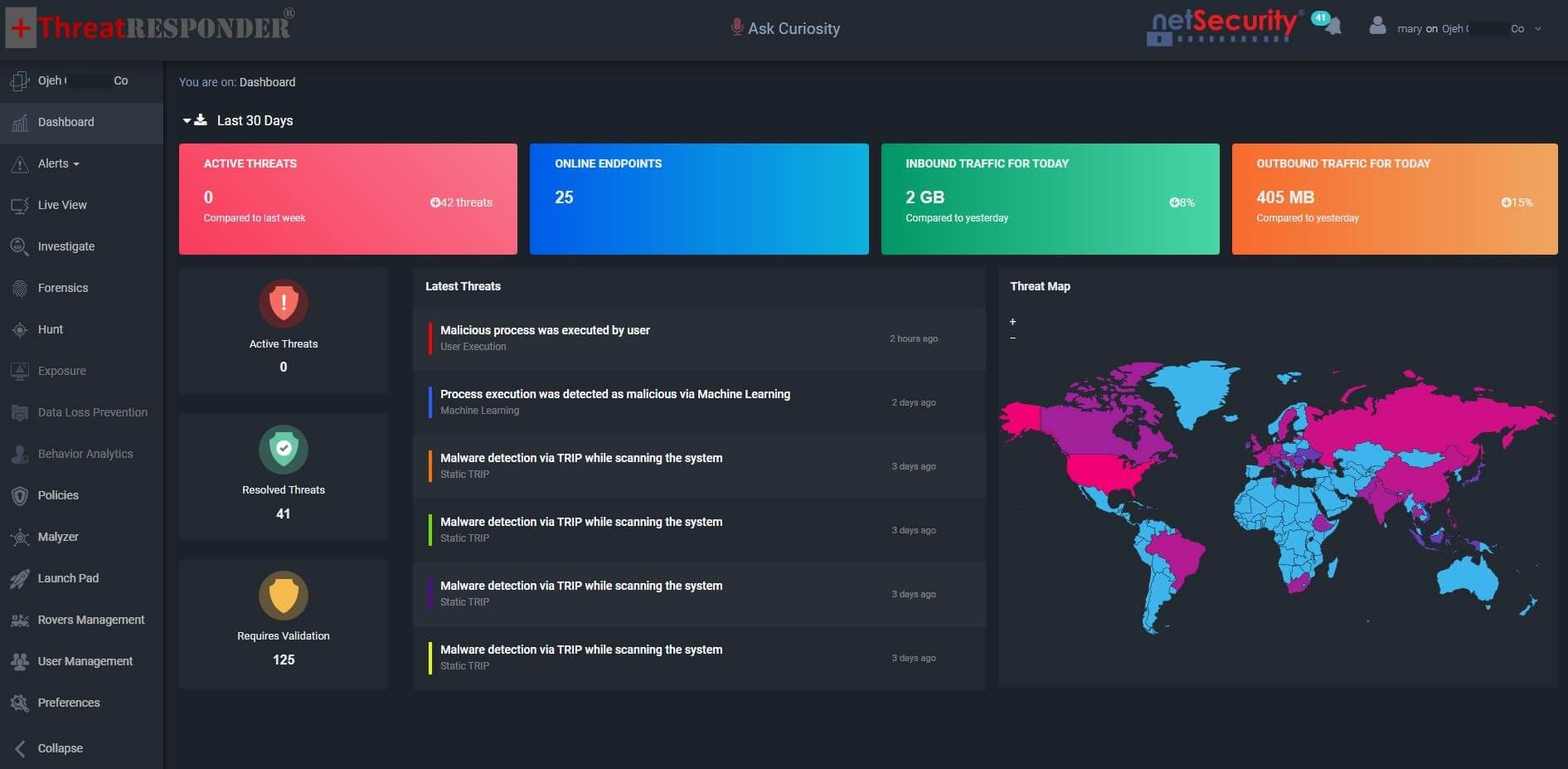
In the fragmentation era, ransomware defense requires unified visibility, fast investigation, and rapid containment. Smaller gangs win when defenders chase isolated alerts across separate consoles and cannot connect early micro-events into a clear intrusion narrative. ThreatResponder is designed to help security teams regain control by making ransomware prevention a cross-domain detection and response problem, not just a malware problem.
Unified threat visibility that connects the dots
ThreatResponder brings together key signals across identity, endpoint, cloud, and network activity to build a single incident storyline. That matters because ransomware precursors often look harmless in isolation. Unified timelines reveal the pattern: suspicious sign-in, privilege misuse, lateral movement, backup access, and data staging.
Early detection of ransomware precursors
ThreatResponder helps surface the behaviors that occur before encryption, including identity anomalies, privilege escalation patterns, unusual remote execution, and backup targeting. This lets your SOC intervene when containment is still feasible and business disruption is still preventable.
Rapid, controlled response to reduce attacker leverage
ThreatResponder enables fast response workflows that disrupt ransomware operations at the stages that matter. Actions like session containment, token revocation, account controls, and endpoint isolation help stop attackers from spreading, exfiltrating, or sabotaging recovery. The emphasis is on controlled response that supports auditability and operational safety.
Better outcomes with less analyst overload
Fragmentation increases noise. ThreatResponder reduces the time analysts spend pivoting across tools by presenting correlated evidence and prioritized risk. That shortens investigation cycles and improves decision-making under pressure, which is critical when smaller gangs move fast.
If your organization is planning ransomware readiness for 2026 and beyond, the winning strategy is not chasing the biggest brand names. The winning strategy is breaking the intrusion chain early, using identity-first detection, narrative correlation, and response speed that matches attacker tempo. ThreatResponder helps you operationalize that approach so ransomware stays a security event, not a business crisis.
Disclaimer
The page’s content shall be deemed proprietary and privileged information of NETSECURITY CORPORATION. It shall be noted that NETSECURITY CORPORATION copyrights the contents of this page. Any violation/misuse/unauthorized use of this content “as is” or “modified” shall be considered illegal and subjected to articles and provisions that have been stipulated in the General Data Protection Regulation (GDPR) and Personal Data Protection Law (PDPL).