Post‑Quantum Reality Check: What Organizations Must Do Before 2030
Quantum computing is no longer a distant research project. While practical, large scale quantum computers are still emerging, security leaders must plan for a world where today’s public key cryptography can be broken. The most urgent risk is the harvest now decrypt later model where attackers intercept and store encrypted data today with the expectation that quantum capabilities will decrypt it in the future. If your organization holds long lived sensitive data such as customer PII, healthcare records, financial data, proprietary algorithms, or national critical infrastructure telemetry, you cannot wait for a quantum headline to begin the transition. The path to post quantum resilience requires inventory, prioritization, crypto agility, and coordinated migration across applications, networks, devices, and third parties.
What quantum threats actually break and what remains safe
Not all cryptography is impacted equally. Understanding scope helps you prioritize effort.
Public key cryptography at risk
Asymmetric schemes that rely on integer factorization or discrete logarithms are vulnerable to quantum algorithms. This includes RSA used for key exchange and signatures, DSA and ECDSA signatures, ECDH for key agreement, and many PKI based authentication workflows. These are foundational to TLS handshakes, VPN tunnels, code signing, email security, and software update trust.
Symmetric cryptography is more resilient
Block ciphers like AES and hash functions like SHA 2 remain viable with sufficient key length and parameters. Quantum speedups apply to brute force and collision search, so defenders should move to AES 256 and SHA 384 or SHA 512 to maintain comfortable security margins.
The data at rest vs data in transit distinction
Data in transit is at higher risk from harvest now decrypt later. Data at rest protected by strong symmetric encryption and robust key management is less exposed, although key wrapping, key distribution, and access control often rely on asymmetric components that need attention.
The business case to act before 2030
Waiting has concrete costs. Contracts, compliance regimes, customer assurances, and product lifecycles already extend beyond 2030 in many organizations. If your company ships devices with a 7 to 15 year lifespan, or archives regulated data for decades, you must ensure that cryptographic choices you make today remain safe for the duration. Early movers gain three advantages. They reduce the long tail cost of emergency upgrades, avoid stranded inventory in IoT and OT, and signal trust to customers and regulators that sensitive data will remain secure across technology shifts.
A practical framework for post quantum readiness
The goal is crypto agility at scale. Achieving it requires a structured program that inventory, evaluates, and migrates cryptography with minimal disruption.
Step 1: Build a complete crypto inventory
You cannot migrate what you cannot see. Create a living inventory that maps cryptographic usage across the organization.
- Protocols and libraries in use such as TLS, SSH, IPSec, S/MIME, PGP, SCP, Kerberos, and custom crypto.
- Algorithms and parameters such as RSA key sizes, ECC curves, DH groups, AES modes, hash functions.
- Key management components such as HSMs, KMS, certificate authorities, code signing services, and secrets vaults.
- Data flows that show where keys are generated, stored, wrapped, rotated, and destroyed.
- Assets and dependencies including servers, containers, client apps, mobile, APIs, databases, SCADA, IoT, and firmware update channels.
Automate discovery where possible using scanning, SBOM ingestion, traffic inspection in non production, and developer attestation in CI pipelines. Treat this as a continuous process, not a one time task.
Step 2: Classify data by sensitivity and longevity
Identify which data must remain confidential beyond 2030 and for how long. Examples include medical records, personally identifiable information, long term contracts, proprietary design files, classified research, and legal archives. The longer the confidentiality requirement, the higher the priority for quantum safe protection today.
Step 3: Prioritize use cases by business risk
Map quantum exposure to business processes.
- External trust and communications such as TLS termination, VPN access, SSO, and customer APIs.
- Trust anchors such as PKI, certificate issuance flows, OCSP, and code signing.
- High value internal trusts such as admin remote access, secrets distribution, and inter service mTLS.
- Long lived devices such as sensors, controllers, and appliances where upgrading cryptography post deployment is costly.
Rank by impact and complexity. Begin with systems that combine high sensitivity and long lifespan.
Step 4: Plan for post quantum cryptography adoption
Modern post quantum strategies favor hybrid approaches first then pure post quantum when standards and interoperability stabilize.
- Key establishment. Use hybrid key exchange that combines a classical algorithm like X25519 with a post quantum KEM to produce a shared secret.
- Signatures. Use hybrid certificates that include both a classical signature and a post quantum signature to maintain compatibility while building quantum safety.
- Certificates and PKI. Update CA tooling, templates, and linting to accept new post quantum algorithms and larger key sizes.
- Libraries and protocols. Verify support in OpenSSL, BoringSSL, wolfSSL, mbedTLS, Java, .NET, Go, Rust, and language specific TLS stacks. Test handshake sizes, handshake latency, and path MTU corner cases.
Step 5: Engineer for crypto agility
Crypto agility means you can change algorithms, parameters, and keys without redesigning applications. Design with abstractions and policy driven selection.
- Centralize crypto policy so applications do not hardcode algorithms.
- Support multiple algorithms simultaneously and negotiate capabilities at runtime.
- Decouple identity from keys so rotating or switching algorithms does not break authorization or identity mapping.
- Use versioned certificate profiles and KMS interfaces to support staged rollouts.
- Include telemetry to observe negotiated algorithms in production so you can verify migration progress.
Step 6: Modernize key management and HSMs
Evaluate whether your HSMs and KMS can generate, store, and operate on post quantum keys. Plan capacity for larger key material and signatures, higher handshake overhead, and the need for higher performance during migration peaks. Review backup and escrow models for PQC compatibility. Ensure key rotation, revocation, and lifecycle policies reflect the new algorithms.
Step 7: Update governance, procurement, and vendor risk
Make PQC support a first class requirement in RFPs, vendor assessments, and contracts. Require software suppliers to provide cryptographic SBOM fields and a migration roadmap that covers both KEM and signature algorithms. For managed services, verify that tenant to tenant and control plane to data plane communications will be protected with hybrid or PQC by specific dates.
Step 8: Test at scale before production
Build a dedicated PQC test environment. Validate end to end scenarios with representative latency and packet loss. Measure handshake size, certificate chain size, CPU impact, and memory footprint. Exercise disaster recovery and validate that break glass procedures still function when PQC is enabled. Include downgrade attack testing and validate that hybrid modes are negotiated correctly when classical algorithms are stripped by a man in the middle.
Where to start migrating and why
All migrations are not equal. Focus on high leverage areas first.
TLS for public facing services
Public APIs, customer portals, and partner integrations often carry long term or sensitive data and are exposed to interception risks. Implement hybrid TLS handshakes where client compatibility permits. Consider staging by region and by user agent to reduce blast radius.
Remote access and site to site VPN
Migrate IPSec and SSL VPNs to hybrid key exchange to protect administrative sessions and cross site traffic. Train helpdesk to handle client profile updates and certificate distribution changes.
Code signing and software update channels
If adversaries can forge signatures post quantum, the integrity of software distribution breaks. Move build pipelines and signing infrastructure to support PQC or hybrid signatures and test update verification across the installed base.
PKI and certificate lifecycle
Refresh your PKI hierarchy to support PQC capable intermediates and leaf issuance. Introduce hybrid certificates in non critical paths, evaluate revocation behavior, and prepare for larger OCSP responses and CRLs.
Sensitive data archives and backups
For data that must remain confidential beyond 2030, reencrypt with strong symmetric schemes using keys protected by PQC aware key wrapping and distribution. Verify restore procedures and key escrow compatibility.
IoT, OT, and long lived embedded systems
Devices deployed today may still be operational in the 2030s. Introduce PQC readiness in firmware, bootloaders, and secure update mechanisms. Where resources are limited, plan for gateway based PQC termination with careful threat modeling.
Managing performance, size, and interoperability
PQC brings larger keys and signatures and different performance characteristics. Plan for these realities rather than assuming parity.
Network and protocol considerations
Larger certificates and handshakes can cause fragmentation and path MTU issues. Validate that load balancers, proxies, and middleboxes correctly handle larger TLS records. Monitor handshake failure rates and retransmissions during pilots.
Storage and logging impact
Certificate stores, HSM partitions, and logs will grow. Plan capacity, archiving strategies, and indexing performance. Update SIEM parsing rules for new OIDs, algorithm names, and extended certificate fields.
Client and ecosystem readiness
Not all clients will support hybrid or PQC immediately. Segment traffic, offer capability detection, and maintain fallbacks for compatibility. Track adoption metrics and deprecate weak options on a timeline communicated to partners and customers.
Security operations and incident response in a PQC world
PQC is not a set and forget upgrade. It changes how you detect, investigate, and respond.
Telemetry and detections
Add detections for unexpected algorithm downgrades, sudden spikes in handshake failures, and abnormal certificate chain sizes. Monitor for unauthorized issuance of PQC capable certificates and anomalous key generation events in KMS and HSMs.
Playbooks and readiness drills
Update IR playbooks to include PQC aware containment and recovery steps. Run tabletop exercises that simulate certificate compromise when hybrid modes are in use. Ensure that key revocation and rapid reissuance are tested at scale.
Metrics and executive reporting
Define program metrics that matter. Track percentage of critical services using hybrid or PQC, percentage of long lived data reencrypted under quantum safe controls, PQC capable vendor coverage, and time to rotate keys and certificates in emergency scenarios. Report progress quarterly to maintain executive alignment.
A 36 month roadmap you can adopt today
Breaking the journey into phases makes it achievable.
Months 0 to 6: Discovery and design
- Complete crypto inventory and data classification.
- Establish governance and funding.
- Select priority use cases and define success metrics.
- Validate library and vendor support in a lab.
- Draft crypto agility standards and developer guidance.
Months 6 to 18: Pilot and initial rollout
- Implement hybrid TLS for a subset of public services.
- Upgrade PKI to issue hybrid capable leaf certificates.
- Enable PQC aware KMS interfaces and test key lifecycles.
- Pilot code signing with hybrid signatures in a non production pipeline.
- Begin reencrypting high priority archives and backups.
Months 18 to 36: Scale and deprecation
- Expand hybrid to all customer facing endpoints and major internal services.
- Migrate VPNs and administrative access paths.
- Roll out PQC aware firmware updates and secure boot changes for devices.
- Establish deprecation timelines for classical only algorithms and communicate externally.
- Bake PQC checks into CI, CD, and change management.
How ThreatResponder supports the post quantum transition
Quantum readiness is not only a cryptography project. It is also a detection and response challenge. During migration, attackers may attempt downgrade attacks, exploit misconfigurations, or target key management systems. ThreatResponder helps reduce that risk.
Unified visibility during crypto change
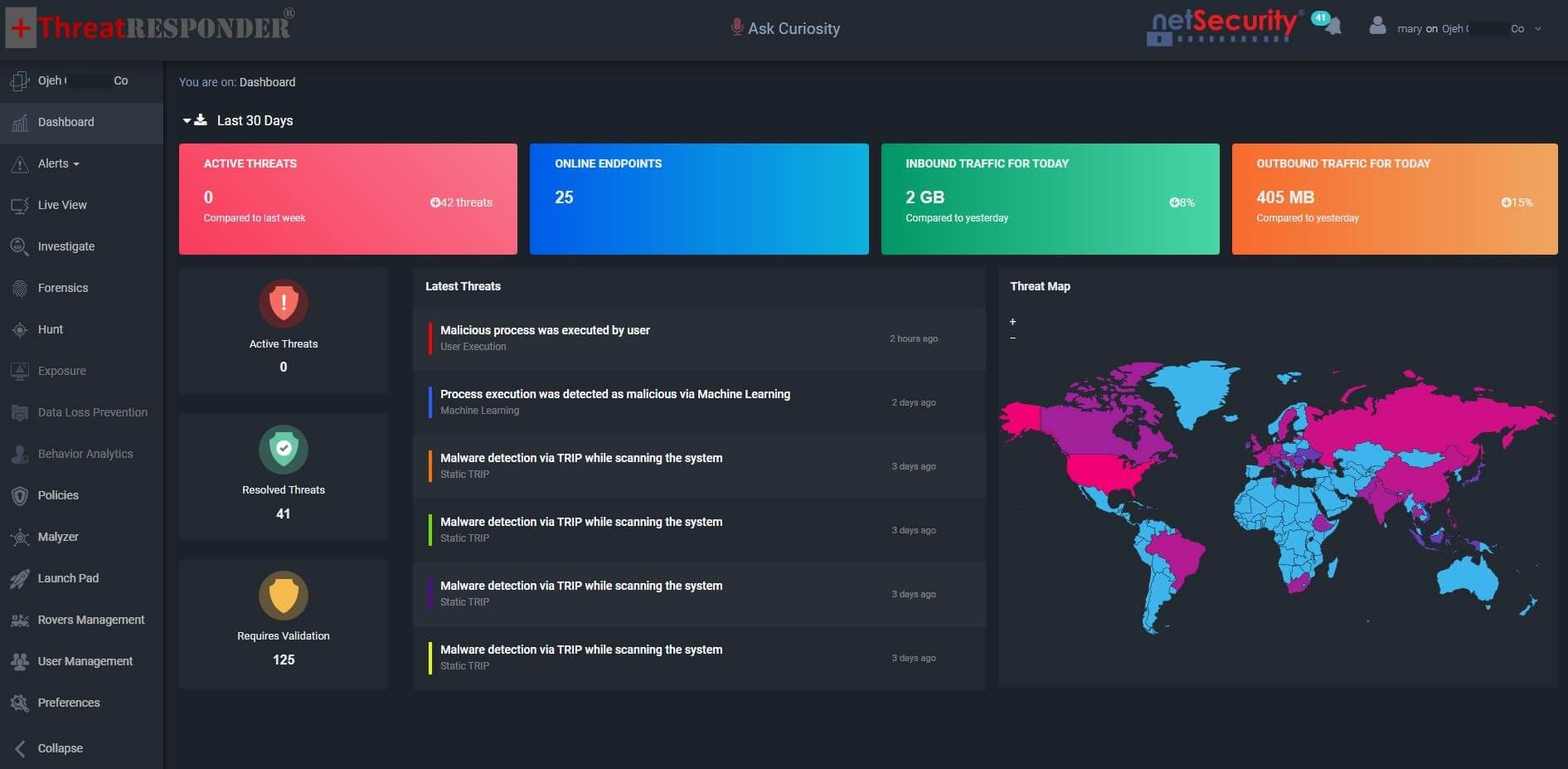
ThreatResponder correlates identity, endpoint, network, and certificate telemetry so your SOC can see where hybrid handshakes are in use, which services still negotiate classical only ciphers, and where policy drift or shadow services appear.
Early detection of downgrade and misuse
By focusing on behavior across sessions and systems, ThreatResponder highlights suspicious negotiation patterns, unauthorized certificate issuance, unexpected key generation in KMS, and privileged changes in PKI and HSM consoles that could indicate compromise.
Rapid, controlled response
When quantum era threats target your trust fabric, speed matters. ThreatResponder helps orchestrate safe containment such as disabling affected certificates, revoking tokens, and isolating endpoints that exhibit malicious handshake tampering while preserving business continuity.
Less noise, more action
PQC migration will create new logs, larger events, and unfamiliar signals. ThreatResponder reduces analyst overload by turning raw telemetry into prioritized, narrative driven incidents so teams can focus on the few events that threaten the integrity of your trust architecture.
The bottom line
Post quantum security is a business resilience program. The goal is simple. Ensure that the data you must protect in the 2030s and beyond remains secure, and that your trust relationships continue to work when the cryptography beneath them changes. Start with inventory and data longevity, design for crypto agility, pilot hybrid deployments, modernize PKI and KMS, and extend detection and response to protect the migration itself. The organizations that treat 2030 as a planning anchor will avoid rushed, high risk changes and will meet customer and regulatory expectations with confidence. ThreatResponder is here to help you detect and mitigate the operational and security risks that emerge along the way so the path to quantum safety is both secure and manageable.
In a world where identity is the perimeter, protecting credentials is only the starting point. Detecting misuse, correlating behavior, and responding decisively determine whether a stolen credential becomes a minor security event or a total compromise. ThreatResponder helps organizations operate at that level by turning identity into a strength rather than a single point of failure.
Disclaimer
The page’s content shall be deemed proprietary and privileged information of NETSECURITY CORPORATION. It shall be noted that NETSECURITY CORPORATION copyrights the contents of this page. Any violation/misuse/unauthorized use of this content “as is” or “modified” shall be considered illegal and subjected to articles and provisions that have been stipulated in the General Data Protection Regulation (GDPR) and Personal Data Protection Law (PDPL).