Identity Is the New Perimeter: How One Stolen Credential Leads to Total Compromise
Traditionally, security strategy revolved around protecting a clearly defined perimeter. Firewalls, intrusion prevention systems, network segmentation, and VPNs were designed to keep attackers out and users in. That model assumed that once an attacker breached the perimeter, the damage would be contained or at least detectable. That assumption no longer holds.
The perimeter did not disappear. It moved
Modern enterprises operate across cloud platforms, SaaS applications, remote workforces, APIs, and hybrid environments. Users log in from anywhere. Applications live outside the traditional network. Infrastructure is spun up and torn down continuously. In this reality, the most consistent control plane is identity.
Identity is how access is granted. Identity is how permissions are enforced. Identity is how actions are attributed. When identity is compromised, the attacker does not need to break in. They simply log in.
This is why identity is now the perimeter. And it is why a single stolen credential can lead to total compromise.
Why identity has become the primary attack surface
Attackers follow value and efficiency. Identity offers both.
Stealing credentials is often easier and more reliable than exploiting software vulnerabilities. Phishing kits, infostealers, credential reuse, MFA fatigue, OAuth abuse, and token theft all provide pathways to valid access. Once an attacker has credentials, they inherit the trust associated with that identity.
Identity has become the gateway to:
- Cloud management consoles
- SaaS applications
- Email and collaboration platforms
- Source code repositories
- CI/CD pipelines
- Backup systems
- Security tooling itself
Traditional perimeter controls do little to stop an attacker who is already authenticated. This shift has fundamentally changed how breaches occur and how they must be detected.
The collapse of the trust boundary
In the past, network location played a major role in trust decisions. Internal traffic was trusted more than external traffic. Today, that distinction is blurred or gone entirely.
Users authenticate directly to cloud services. Applications communicate through APIs. Service accounts operate without human interaction. Trust is granted based on identity context, not network location.
When identity is compromised, the trust boundary collapses silently.
How one stolen credential turns into full environment compromise
Most major breaches no longer begin with malware detonating on a workstation. They begin with valid access. The path from a single stolen credential to total compromise follows a predictable pattern.
Stage 1: Initial access through credential compromise
The first step is obtaining valid credentials. This can happen through phishing, credential stuffing, infostealer malware, MFA fatigue attacks, or OAuth abuse. In many cases, attackers do not need privileged credentials at the start. A low-privilege user is often enough.
Once the attacker logs in successfully, they appear legitimate. Authentication logs show a valid user. Security tools often treat this as low risk unless context is carefully analyzed.
Stage 2: Establishing persistence through identity
After initial access, attackers seek persistence. In identity-driven environments, persistence does not require malware. It requires access that survives password changes and user scrutiny.
Common persistence techniques include:
- Creating additional user accounts
- Registering OAuth applications
- Generating API tokens or access keys
- Adding MFA methods controlled by the attacker
- Modifying conditional access or security policies
- Abusing service accounts with long-lived credentials
These actions often look like normal administrative changes unless identity activity is closely monitored.
Stage 3: Privilege escalation through misconfigurations
Privilege escalation is frequently achieved by abusing misconfigurations rather than exploiting vulnerabilities. Over-permissioned roles, inherited access, weak separation of duties, and stale privileges provide easy paths.
Attackers enumerate permissions and look for opportunities to:
- Add themselves to privileged groups
- Assign higher roles in cloud platforms
- Exploit automation accounts with excessive access
- Abuse delegated permissions in SaaS platforms
Because these actions are performed through legitimate interfaces, they often bypass traditional security alerts.
Stage 4: Lateral movement using trust relationships
Once privileges increase, attackers move laterally across systems using trusted relationships. Identity enables this movement without noisy exploits.
Examples include:
- Accessing file shares and collaboration tools
- Logging into administrative portals
- Using remote management tools
- Accessing source code repositories
- Pivoting between cloud subscriptions or tenants
Each step leverages trust that already exists. The attacker is not breaking controls. They are using them.
Stage 5: Data access, exfiltration, and operational control
With sufficient access, attackers can reach sensitive data, intellectual property, and business systems. Data exfiltration often occurs quietly through approved channels such as cloud storage, email, or APIs.
At this stage, attackers may also:
- Disable security controls
- Modify logging configurations
- Sabotage backups
- Prepare ransomware deployment
- Establish long-term access for future operations
All of this can occur without triggering traditional perimeter defenses.
Why traditional security tools struggle with identity-based attacks
Many security programs were not designed for identity-first threats. They rely on assumptions that no longer apply.
Authentication success is treated as benign
Most systems treat successful authentication as a positive signal. Alerts focus on failed logins or brute force attempts. When an attacker logs in successfully, the event often fades into background noise.
Without contextual analysis, security teams miss the fact that the login itself is the attack.
Identity telemetry is fragmented
Identity data lives across identity providers, cloud platforms, SaaS applications, and on-prem systems. Logs are often siloed and analyzed separately. This fragmentation prevents analysts from seeing the full picture.
An unusual login may appear harmless until correlated with privilege changes, data access, and lateral movement.
Privileged access is poorly governed
Many organizations struggle with privilege sprawl. Users accumulate access over time. Service accounts are over-permissioned. Temporary access becomes permanent.
Attackers exploit this sprawl to escalate privileges without triggering alarms.
Incident response focuses on endpoints, not identities
Traditional response playbooks often focus on isolating endpoints, removing malware, and reimaging systems. Identity compromise requires different actions: token revocation, session termination, role review, and access rollback.
Without identity-aware response, attackers retain access even after endpoints are cleaned.
Identity-driven attacks blur the line between insider and external threat
One of the most challenging aspects of identity compromise is attribution. When attackers operate using valid credentials, their actions resemble insider activity.
Security teams must distinguish between:
- Legitimate user behavior
- Negligent mistakes
- Malicious insider actions
- External attackers using compromised identities
This ambiguity increases investigation time and uncertainty. It also raises the risk of delayed response while teams debate intent.
The new detection strategy: identity-first threat detection
Defending the modern perimeter requires a shift in detection philosophy. Identity must be treated as a primary signal, not an afterthought.
Monitor behavior, not just authentication
Successful authentication should not end scrutiny. It should begin it. Security teams must analyze what happens after login.
Key behaviors to monitor include:
- Unusual access patterns across applications
- Rapid privilege changes
- First-time access to sensitive systems
- Abnormal session duration or activity volume
- Use of identities outside typical workflows
Behavioral baselining helps identify deviations that indicate compromise.
Correlate identity with endpoint, cloud, and data activity
Identity events rarely tell the full story alone. They must be correlated with other telemetry to reveal intent.
Effective detection connects:
- Login events with endpoint activity
- Identity usage with cloud resource changes
- User sessions with data access patterns
- Privilege changes with lateral movement
This correlation turns isolated signals into actionable narratives.
Treat service accounts and machine identities as high risk
Machine identities often have broad access and weak oversight. Long-lived keys and tokens are attractive targets.
Detection programs must include:
- Monitoring of service account usage patterns
- Alerts on new key creation and permission changes
- Visibility into API activity and automation behavior
Ignoring machine identities creates blind spots that attackers exploit.
Response must be identity-aware and immediate
Detection without response is insufficient. When identity is compromised, speed matters.
Contain sessions, not just devices
Identity response requires actions beyond endpoint isolation. Effective containment includes:
- Revoking active sessions
- Invalidating tokens and keys
- Forcing reauthentication
- Temporarily disabling accounts
- Rolling back privilege changes
These actions stop attacker momentum immediately.
Investigate access paths, not just incidents
Response teams must trace how access was obtained and expanded. This includes reviewing:
- Authentication history
- Privilege changes
- OAuth consents
- Service account usage
- Policy modifications
Understanding the access path prevents reinfection and future compromise.
Recover trust deliberately
Restoring trust after identity compromise takes more than password resets. Organizations must validate access, reissue credentials, and verify configurations.
Skipping this step leaves residual risk that attackers can exploit later.
What CISOs should prioritize in an identity-first world
Identity-centric risk demands changes in strategy, metrics, and investment.
Key priorities include:
- Treating identity as critical infrastructure
- Reducing standing privileges across the organization
- Enforcing strong authentication everywhere
- Monitoring identity behavior continuously
- Integrating identity signals into SOC workflows
- Measuring time to detect and contain identity misuse
CISOs should assume credential compromise will occur and design controls to limit blast radius and dwell time.
Common myths that increase identity risk
Several persistent myths undermine identity security.
Myth 1: MFA solves identity compromise
MFA reduces risk but does not eliminate it. MFA fatigue, token theft, and misconfigurations still enable compromise. Detection and response remain essential.
Myth 2: Only privileged accounts matter
Low-privilege accounts often provide the foothold. Attackers escalate later. Ignoring non-privileged identities delays detection.
Myth 3: Identity attacks are insider problems
External attackers increasingly operate through compromised identities. Treating identity misuse as purely an insider issue limits visibility and response.
How ThreatResponder helps stop identity-based compromise
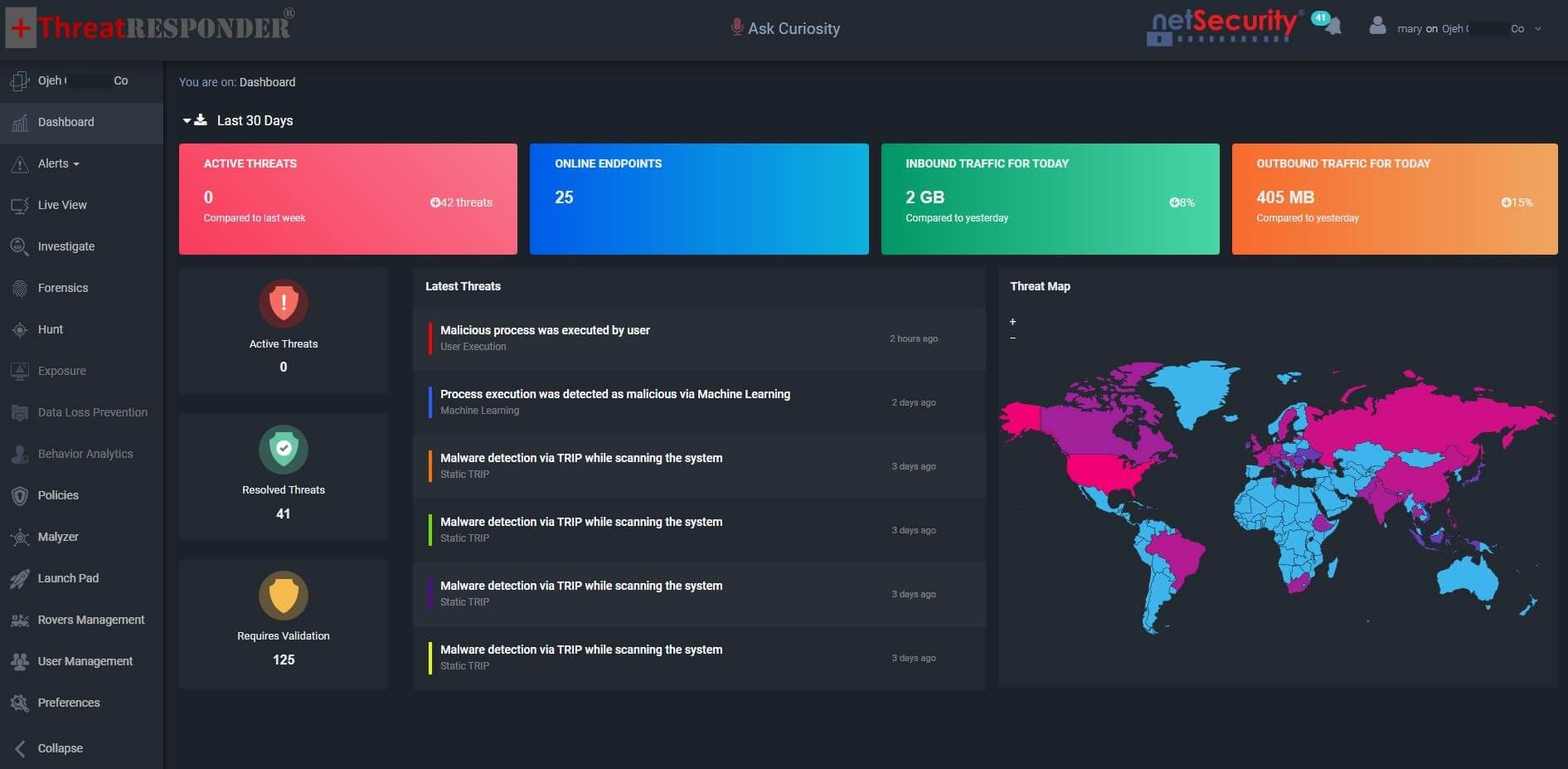
Identity-driven attacks succeed when security teams lack unified visibility, behavioral context, and fast response. ThreatResponder is designed to address these challenges by making identity a core component of threat detection and response.
Unified visibility across identity and activity
ThreatResponder connects identity signals with endpoint, cloud, and data activity to build complete incident narratives. This helps analysts see how a single credential is used across the environment and how risk evolves over time.
Early detection of identity misuse
By focusing on behavior and sequence rather than isolated events, ThreatResponder surfaces suspicious identity activity before it escalates into full compromise. This includes detecting unusual access patterns, privilege abuse, and lateral movement tied to identities.
Rapid response to cut off attacker access
ThreatResponder supports fast, controlled response actions that focus on identity containment. Revoking sessions, disabling accounts, and rolling back access can stop attackers before they reach critical assets.
Reduced investigation time and analyst fatigue
By presenting correlated evidence and prioritized risk, ThreatResponder helps SOC teams move faster with higher confidence. This is essential when attackers rely on speed and stealth rather than brute force.
In a world where identity is the perimeter, protecting credentials is only the starting point. Detecting misuse, correlating behavior, and responding decisively determine whether a stolen credential becomes a minor security event or a total compromise. ThreatResponder helps organizations operate at that level by turning identity into a strength rather than a single point of failure.
Disclaimer
The page’s content shall be deemed proprietary and privileged information of NETSECURITY CORPORATION. It shall be noted that NETSECURITY CORPORATION copyrights the contents of this page. Any violation/misuse/unauthorized use of this content “as is” or “modified” shall be considered illegal and subjected to articles and provisions that have been stipulated in the General Data Protection Regulation (GDPR) and Personal Data Protection Law (PDPL).