Agentic AI Attacks Are Here: Why Traditional Detection Is Already Obsolete
The new reality: attacks that plan, adapt, and execute on their own
Security teams have spent decades building detection programs around a familiar assumption: attackers act in steps that are predictable enough to model. A phishing email lands, malware executes, persistence is established, lateral movement begins, and then the attacker monetizes. Even when adversaries became stealthier, most defensive tooling still relied on the idea that malicious behavior would show up as a recognizable pattern in logs, endpoint telemetry, or network signals.
Agentic AI changes that assumption.
Agentic AI attacks are not just “AI-assisted.” They are built to operate as goal-driven systems that can decide what to do next based on what they observe. Instead of following a static script, an agent can explore an environment, test hypotheses, pick new tactics, and continuously adjust until it reaches an objective like credential theft, data exfiltration, account takeover, or ransomware deployment.
That shift is why traditional detection is already obsolete for many organizations. Not because existing tools stop working entirely, but because their core operating model is too slow, too brittle, and too dependent on known patterns. Agentic attackers make the security gap wider by turning reconnaissance, exploitation, and evasion into an adaptive loop that can run faster than analysts can triage alerts.
This post explains what agentic AI attacks are, why they break conventional security controls, what new detection and response principles are required, and how to modernize your security operations to keep pace. It ends with a practical “what to do next” framework and a closing section on how ThreatResponder helps you operationalize it.
What are agentic AI attacks in cybersecurity?
Agentic AI attacks use autonomous or semi-autonomous agents that can perform multi-step operations with minimal human input. Think of an agent as a system that receives a goal, like “gain access to finance data,” and then iteratively performs actions to reach that goal while adapting to constraints and feedback.
In practice, agentic behavior can show up in several ways:
- Autonomous reconnaissance that maps identities, permissions, and exposed services.
- Dynamic selection of initial access techniques based on what is easiest in the moment.
- Rapid iteration on social engineering pretexts based on responses and environment cues.
- Tool switching to avoid endpoint detections or network blocks.
- Opportunistic privilege escalation using whatever misconfiguration is discovered.
- Context-aware lateral movement that mimics legitimate administrative workflows.
- Automated cleanup and anti-forensics tailored to each environment.
The scary part is not that every attack will be fully autonomous. The scary part is that even partial autonomy is enough to overwhelm traditional SecOps. If an agent can iterate through hundreds of small experiments, each one low-noise, it can find a path that looks “normal” in isolation. Traditional detection often flags spikes, known bad indicators, and well-labeled sequences. Agentic attacks are designed to avoid all three.
Agentic AI vs automation: why the difference matters
Security teams already deal with automation in attacks, like botnets, credential stuffing, and basic phishing kits. Agentic AI is different because it adds decision-making and adaptation.
Automation follows a playbook. Agentic AI can write the playbook as it goes.
This matters because conventional detections, including signatures, indicator matching, and fixed behavioral rules, assume the attacker repeats techniques at scale. Agentic attackers do not need to repeat. They need to succeed once.
Why traditional detection fails against agentic adversaries
Traditional detection programs depend on a mix of known indicators, predefined rules, and correlation logic that assumes an attack has recognizable phases. Agentic AI erodes each pillar.
1) Indicators of compromise arrive too late
Classic indicator-based detection is reactive by design. It works best when there is a known malware hash, a known domain, or a known tool signature. Agentic AI attacks can generate fresh infrastructure, rotate identities, and use legitimate services to blend in. Even when a domain is malicious, it may only be used briefly, then abandoned.
If your detection relies on “known bad,” you will always be behind.
2) Rule-based analytics are brittle in the face of adaptation
Rules are built on expected behavior, like “PowerShell spawned by Office” or “unusual geolocation login.” Attackers have learned to step around these. Agentic AI accelerates that process by testing variations until a rule does not trigger. It can also spread activity across time to avoid thresholds. Instead of one loud event, you get a constellation of small ones.
Rules are not useless, but they are not sufficient when the adversary can probe your controls like a scientist.
3) Alert-driven workflows collapse under micro-events
Many SOCs operate on an alert queue model: tools generate alerts, analysts triage, and incidents are escalated. Agentic AI attacks produce a pattern of “micro-events” that are individually ambiguous. Each event is not clearly malicious, but together they form a campaign.
The problem is that the SOC rarely sees “together.” Telemetry is fragmented across identity systems, endpoints, cloud services, email, and network logs. Analysts end up stuck in swivel-chair investigations while the agent continues moving.
4) “Living off the land” becomes the default, not the exception
Agents can prefer native tools and legitimate administration paths to avoid dropping malware. They can use built-in OS utilities, cloud-native APIs, and legitimate remote management. Many organizations already struggle to differentiate good admin behavior from malicious admin behavior.
Agentic attacks do not need exotic malware if your environment already contains enough legitimate power to do harm.
5) Traditional correlation assumes linear kill chains
A lot of detection logic assumes a linear kill chain: initial access leads to execution leads to persistence leads to lateral movement. Agentic behavior is not linear. It is opportunistic. The agent may switch goals, backtrack, pause, and pivot based on friction.
If your correlation engine expects linear sequences, it will miss non-linear campaigns.
The shift defenders must make: from detection to decision advantage
To defend against agentic AI, your goal is not “detect everything.” Your goal is to gain decision advantage. That means creating an environment where the attacker cannot iterate cheaply and cannot maintain initiative.
Here are the strategic shifts required.
Shift 1: Treat identity as the primary attack surface
In modern enterprises, identity is the control plane. If an agent gets credentials, tokens, or session access, it can operate with legitimate permissions. That is why identity telemetry must be first-class.
What to focus on:
- Authentication anomalies that align with privilege changes, not just location.
- Token misuse and impossible sequences across SaaS and cloud.
- High-risk sign-ins followed by access to sensitive resources.
- Privilege escalations that are subtle, like role assignments in cloud consoles.
Shift 2: Move from static rules to adaptive behavioral baselines
Agentic attackers exploit the gap between “normal enough” and “obviously malicious.” Behavioral baselines help you measure intent through context and deviation.
What to focus on:
- Entity behavior analytics for users, service accounts, and devices.
- Peer group comparisons, not global averages.
- Sequences of actions that are unusual together, even if each is common.
Shift 3: Prioritize narrative correlation over alert correlation
Most SOCs correlate alerts. Agentic defense requires correlating narratives: who did what, from where, using which identity, touching which assets, and why it matters.
What to focus on:
- Session-level timelines that combine identity, endpoint, and cloud actions.
- Attack-path mapping, not just event linking.
- Risk scoring that updates as new evidence arrives.
Shift 4: Build response that is fast, safe, and reversible
When an attacker moves faster than analysts, response must be automated. But automation must be controlled. The answer is not random auto-remediation. The answer is policy-driven response with guardrails and rollbacks.
What to focus on:
- Pre-approved containment actions for high-confidence scenarios.
- Step-up authentication, token revocation, and conditional access changes.
- Endpoint isolation, process termination, and network segmentation.
- Case management that records actions and supports auditability.
Shift 5: Reduce the attacker’s experimentation surface
Agents win by trying many small things. Defenders win by making experimentation expensive.
What to focus on:
- Tightening privileges and removing unused standing access.
- Hardening cloud configurations and enforcing least privilege.
- Removing exposed services and enforcing strong authentication.
- Deception techniques that create high-signal tripwires.
Common agentic AI attack scenarios you should expect
Agentic attacks will look different across industries, but certain patterns are emerging as “high yield” because they offer fast learning and low risk.
Scenario 1: Autonomous social engineering with continuous refinement
An agent crafts highly contextual messages using public data and internal patterns, then refines the approach based on replies, timing, and organizational jargon. It can rotate pretexts quickly and test which personas get the fastest compliance.
Defensive takeaway: email security alone is not enough. You need identity and workflow anomaly detection that catches unusual approvals, forwarding rules, or credential use that follows communication spikes.
Scenario 2: Credential discovery and privilege escalation as a search problem
An agent enumerates permissions, hunts for misconfigurations, checks password vault exposures, and tests role assignment edges. It treats privilege escalation like a graph search.
Defensive takeaway: monitor role changes, access policy edits, new OAuth app consents, and service account key creation. These are often the real “malware” in cloud environments.
Scenario 3: Lateral movement that mimics IT operations
Instead of noisy scans, an agent uses “admin-like” pathways: remote management tools, helpdesk workflows, and approved SaaS integrations. It moves slowly, choosing the least suspicious path.
Defensive takeaway: baseline admin behavior and enforce separation of duties. If the same identity is doing helpdesk resets and accessing finance data, that is a story worth investigating.
Scenario 4: Data discovery and exfiltration in tiny chunks
Agents can avoid exfiltration spikes by dripping data through legitimate channels like cloud sync, API calls, or collaboration tools. The signal is not bandwidth. The signal is unusual access patterns and unusual destinations.
Defensive takeaway: prioritize sensitive data access analytics and outbound destination trust scoring. Watch for first-time access, unusual query patterns, and sudden permission expansions.
A practical blueprint to modernize detection for agentic threats
If you want an actionable plan, use this five-layer blueprint. It is designed for SOC leaders, CISOs, and security architects who need measurable improvement.
Layer 1: Consolidate telemetry into a unified threat view
You cannot beat an agent with fragmented context. Unify endpoint, identity, cloud, email, and network signals into one investigation surface. If analysts need five consoles, you already lost time.
Outcome metric: time to build a complete incident timeline.
Layer 2: Elevate identity detection and response to a primary control
Implement identity threat detection and response capabilities that can detect token abuse, risky sessions, and privilege misuse. Include machine identities and service accounts in the same program.
Outcome metric: time to detect and contain suspicious sessions.
Layer 3: Implement behavior-based detections that adapt
Build detections around behaviors and sequences, not single events. Continuously tune baselines and incorporate feedback from investigations to reduce false positives without blinding the SOC.
Outcome metric: reduction in false positives without reduction in true positive capture.
Layer 4: Automate response with guardrails
Create response playbooks that trigger on high-confidence narratives. Automate containment actions that reduce attacker options, like token revocation, account disablement, device isolation, and privilege rollback.
Outcome metric: mean time to respond and percentage of incidents contained automatically.
Layer 5: Run agentic attack simulations
Test your environment the way an agent would: try to find paths, not vulnerabilities. Focus on identity misconfigurations, SaaS permissions, cloud roles, and workflow abuse.
Outcome metric: number of exploitable attack paths eliminated per quarter.
What CISOs should tell the board right now
Agentic AI attacks change the security conversation at the executive level. Here is the board-ready framing:
- Risk is shifting from “breach likelihood” to “time-to-impact.” Agents reduce time-to-impact.
- Traditional control maturity does not equal resilience against adaptive threats.
- Identity and response speed are now business continuity controls.
- Security investment should prioritize unified visibility and rapid containment, not more isolated point tools.
If leadership understands that the enemy can iterate faster than human processes, funding and prioritization become easier. The goal is to modernize operations so humans supervise strategy while machines execute safe, rapid defensive actions.
How ThreatResponder helps you stay ahead of agentic AI attacks
Agentic attacks succeed when defenders lack unified context, cannot connect micro-events into a campaign, and cannot respond fast enough to disrupt the attacker’s learning loop. ThreatResponder is built to close that gap by helping security teams move from alert chasing to narrative-driven detection and rapid response.
Unified visibility that reveals the full story
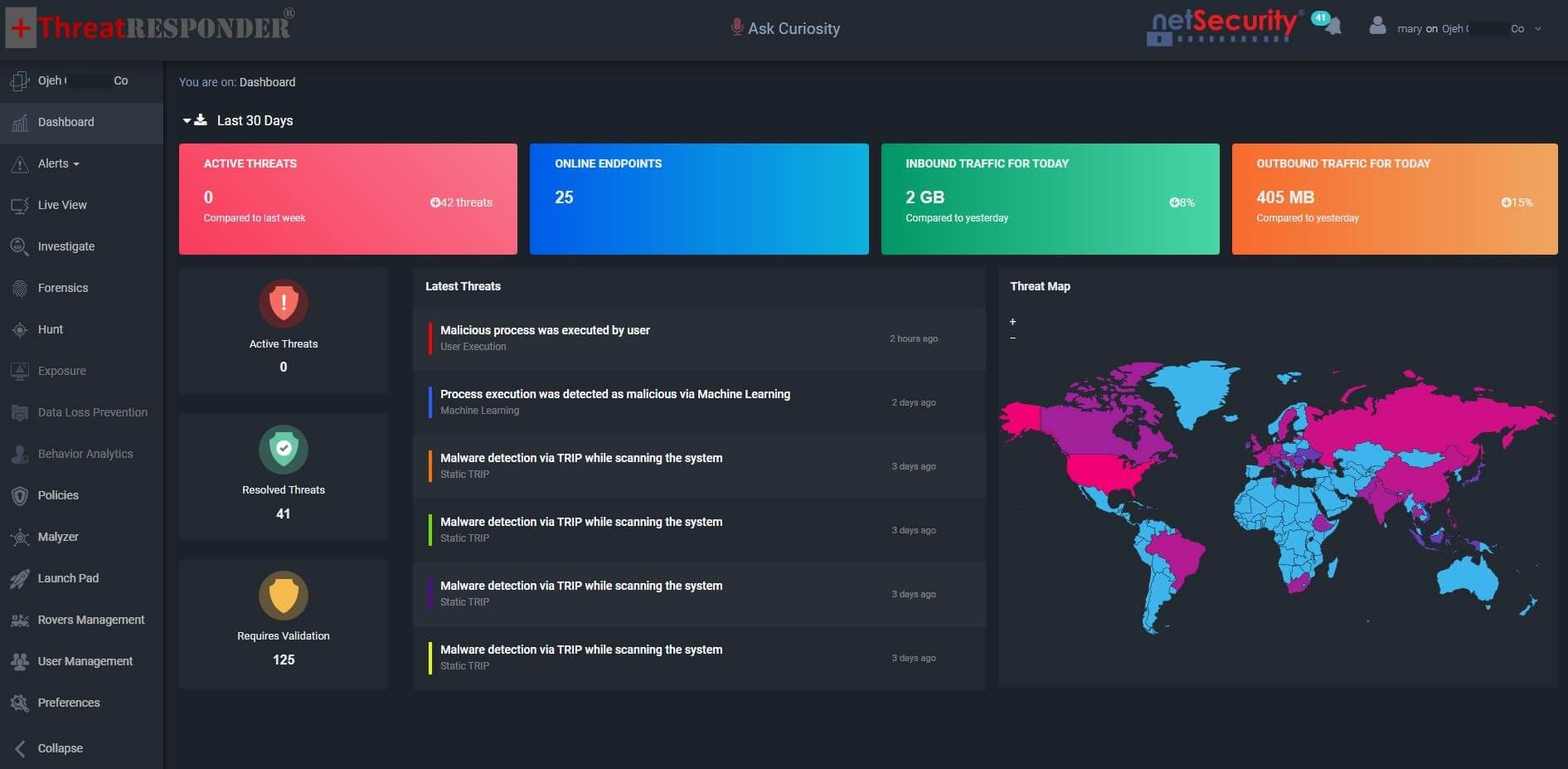
ThreatResponder connects identity, endpoint, cloud, and network signals so your analysts can see a single, coherent timeline. Instead of investigating disconnected alerts, you get a stitched narrative that shows who did what, where it happened, and how the attacker progressed.
Behavior-based detection tuned for modern tradecraft
ThreatResponder emphasizes suspicious sequences and deviations that matter, including identity misuse, privilege shifts, and admin-like activity that does not match baseline behavior. This is essential when agentic attackers avoid traditional indicators.
Faster containment with response workflows built for reality
ThreatResponder helps operationalize rapid, controlled response actions that reduce attacker options quickly. When an agent tries to pivot, you can revoke tokens, contain endpoints, and cut off lateral movement paths before the campaign reaches impact.
A practical path to decision advantage
Most importantly, ThreatResponder supports decision advantage: compressing investigation time, improving confidence in what is happening, and enabling fast, safe action. That is how you stop agentic AI attacks that are designed to outpace human-only processes.
If you are planning your next security operations upgrade, make your benchmark simple: can your program detect and disrupt adaptive, non-linear attacks fast enough to prevent business impact? ThreatResponder is designed to help you answer “yes” with measurable improvements in visibility, investigation speed, and response time.
Disclaimer
The page’s content shall be deemed proprietary and privileged information of NETSECURITY CORPORATION. It shall be noted that NETSECURITY CORPORATION copyrights the contents of this page. Any violation/misuse/unauthorized use of this content “as is” or “modified” shall be considered illegal and subjected to articles and provisions that have been stipulated in the General Data Protection Regulation (GDPR) and Personal Data Protection Law (PDPL).